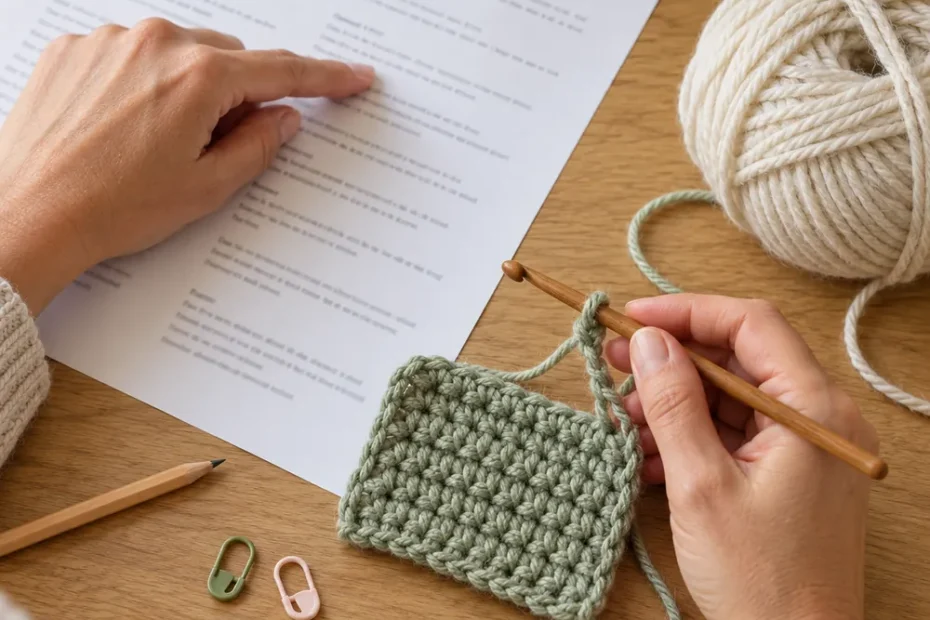
A crochet instruction gives you a stitch to make, a place to put it and an amount to work. Learning how to read a crochet pattern means identifying those details while keeping the designer’s notes in view.
If you are unsure how to read a crochet pattern, begin with its terminology statement and the instructions for your chosen size. Take one line at a time and decide what you need to do before working the stitches.
The practice passages here use US stitch names. They are reading exercises, not a pattern for a finished item.
Open the PDF Before Gathering Your Supplies
Take a few minutes to look through the document from beginning to end. Your first task is to understand its layout.
Perhaps the main piece comes first, with a border explained several pages later. Small decorations might have their own instructions. A garment could involve separate fronts, a back and sleeves, followed by an assembly section.
Make a brief list of the parts you will need to complete. This gives you a way to track progress without relying on the finished photograph.
Check the supplies against that list. Yarn and a hook may cover the main fabric, while the finishing pages call for a needle, buttons or stuffing. Finding those details now saves an interruption later.
Our crochet preparation page includes a few habits worth establishing before you begin.
How to Read a Crochet Pattern With Several Sizes
When several sizes share a document, identify yours before following any stitch numbers.
Suppose a practice pattern labels its options A / B / C, then gives a starting value of 15 / 19 / 23. Choosing B means using 19 at that point. It does not mean switching to the first number when the next instruction looks easier.
Look for the explanation of how sizes are presented. Follow that arrangement throughout the project.
For clothing, compare the supplied measurements with the fit you want. A size name provides less information than the measurements and the designer’s fit notes.
A removable highlight can make your chosen values easier to find. If you prefer a separate notebook, label the entries clearly so you know which part of the pattern each number belongs to.
Resolve the Terminology Before Interpreting “dc”
The letters may look familiar while representing a different stitch system.
In US terminology, dc means double crochet. A UK double crochet corresponds to US single crochet. Working the wrong version changes the fabric, even when you follow every number correctly.
Find the pattern’s US or UK statement. When it is absent, use the stitch explanations to establish the terminology or contact the designer.
Keep a small reference beside you:
| US abbreviation | Stitch name |
|---|---|
| ch | Chain |
| sc | Single crochet |
| hdc | Half double crochet |
| dc | Double crochet |
| sl st | Slip stitch |
The Craft Yarn Council abbreviation reference covers additional terms and the differences between the two systems.
Special stitch definitions need their own attention. If a pattern names a cluster, read its explanation before assuming that a technique from another project applies.
How to Read a Crochet Pattern Instruction
Consider these two directions:
Make 3 dc in the next stitch.
Make 1 dc in each of the next 3 stitches.
Both create three double crochet stitches. The first places them together; the second spreads them across three positions.
That small wording difference affects the design.
When decoding a line, underline the location words in your working copy. “Same,” “next,” “each” and “space” deserve attention because they tell you where the action belongs.
You can also write a plain-language note beside an unfamiliar instruction. Keep it short enough to compare with the original. If your translation changes a location or quantity, correct the note before using it.
Test a Repeat With a Small Calculation
Here is a practice instruction:
[Sc in each of the next 3 sts, 2 sc in the following st] twice.
One pass uses four existing stitches. It produces five: three individual stitches followed by two sharing one position.
Two passes therefore use eight existing stitches and produce ten.
This calculation checks the repeat’s size. It also shows where the extra stitches should appear.
Read the quantity after the group carefully. “Twice” gives two passes altogether. If you have already worked the sequence and are told to repeat it twice more, you will have three passes altogether.
For unfamiliar punctuation, the Craft Yarn Council pattern-reading reference explains common ways designers group instructions.
Understanding where a repeat stops is an important part of learning how to read a crochet pattern. Mark the repeated group in your working copy, then handle any instructions outside that group separately.
Make the Row Edge a Deliberate Decision
Find the turning-chain rule in the notes. Establish whether the chain belongs in the stitch count and where the first working stitch goes.
Carry that rule into the next row. A habit learned from a previous design may not fit the one currently on your hook.
If the starting position remains unclear, stop there and ask. It is easier to describe an uncertain edge while you are looking at it than after several more rows cover the area.
A marker can help you return to a position you have already identified. Use it to preserve a decision, rather than to guess which position is correct.
A Matching Total Still Needs a Placement Check
Counting is useful, but it cannot confirm every detail.
In the ten-stitch exercise above, the two increases belong in specific positions. You could end with ten stitches after placing them elsewhere, yet the arrangement would differ from the instruction.
Compare the work in small sections. Check both the total and the locations of changes.
If a mismatch appears, recount before removing stitches. Then revisit the most recent instruction, looking at repeat boundaries and any skipped, added or reduced stitches.
Leave a note at the last point you checked successfully. That becomes your reference point if you need to retrace the work.
Use the Sample to Confirm Your Materials
Before buying substitute yarn, read the material requirements and any substitution advice. Colour alone does not tell you whether a replacement suits the project.
Where gauge is supplied, follow the sample instructions with the proposed yarn and hook. Compare the required measurement with your stitch and row counts.
A sample that differs needs another check before the main project begins. The Craft Yarn Council gauge sheet explains measuring a swatch and adjusting hook size.
Record the combination you settle on. Include any washing or blocking step the pattern requires before measurement.
Keep this information with your project notes. It becomes particularly useful if you return after a break or need to replace a misplaced hook.
Give Diagrams Their Own Reading Time
When learning how to read a crochet pattern that includes a chart, start with the symbol key and the marked starting point. Check the designer’s directions before following the diagram.
The Craft Yarn Council symbol chart provides standard references, while the pattern’s own key explains any additional symbols.
When written instructions accompany a chart, compare a short passage between them. If the two appear to disagree, request clarification instead of choosing whichever seems simpler.
Keep Notes That Explain Your Stopping Point
“Stopped on sleeve” leaves too much uncertainty.
“Left sleeve: Row 7 finished; Row 8 not started” tells you what to do next.
Record the hook, selected size and any personal adjustments too. Keep changes clearly separate from the original directions so you can explain what you followed if a question arises.
For a repeated section, note how many passes you completed. That prevents a pause from becoming an extra repeat.
Questions Before Your Next Project
Should I memorise the whole abbreviation list?
Learn the terms used in the project you have chosen. Keep the key accessible and review unfamiliar techniques before reaching them.
Can a video help explain an instruction?
Yes, when it demonstrates the method your pattern requires. Confirm its terminology and stitch definition before applying the demonstration.
How do I ask the designer a useful question?
Name the pattern and identify the page, row or round. Describe the instruction you are unsure about and the result you obtained. Add a focused photograph when placement is the problem.
For questions about our designs, the Mehroosh Crochet contact page provides the Etsy messaging route.
Do I need to finish a project in one sitting?
No. Leave a clear progress note and confirm it against your work when you return. A reliable stopping record helps you continue without guessing.
Pick a Design With Requirements You Understand
Knowing how to read a crochet pattern helps you decide what to prepare, where to pause and which question to ask. Keep your reference notes nearby and check unfamiliar instructions before committing them to the fabric.
Browse the Mehroosh Crochet premium pattern collection when you are ready to choose a project. Review the listing’s materials and techniques first, then select a design you can prepare for with confidence.