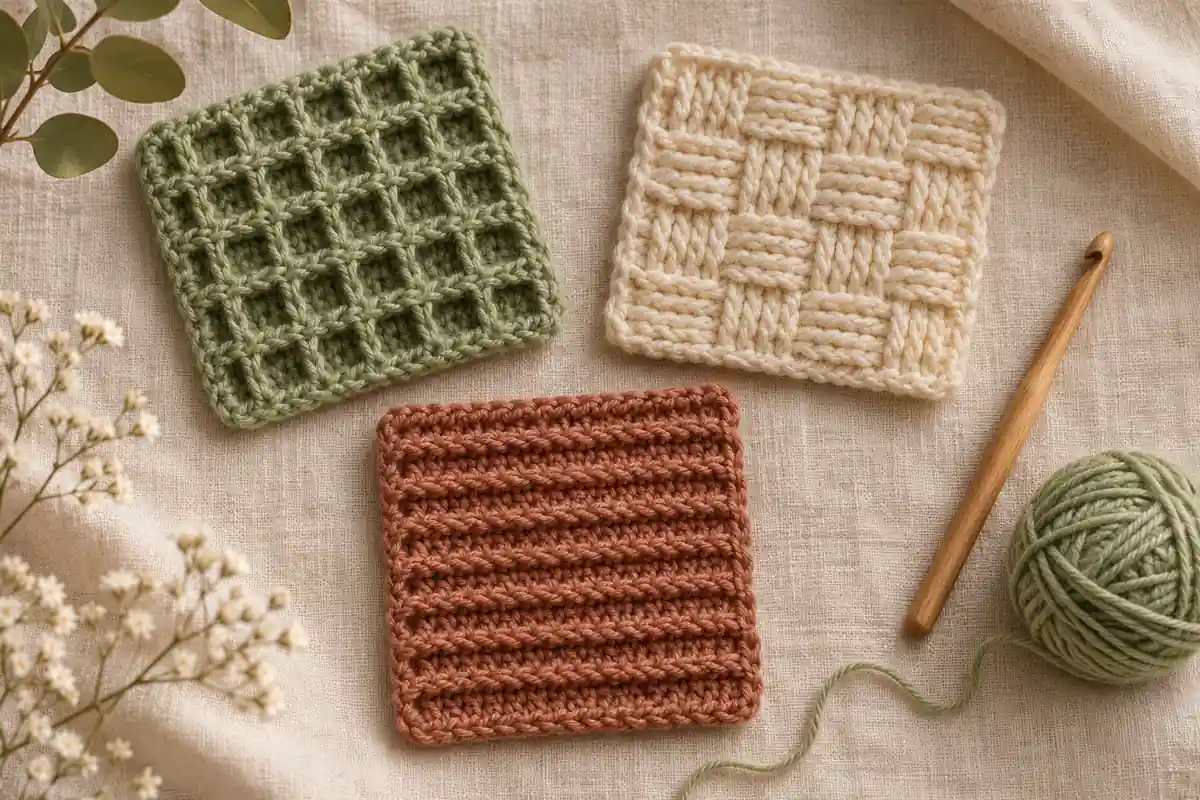
Textured crochet stitches can send your hook into a top loop, around a post or down to an earlier row. Start at the foot of the mark and follow it to the insertion point. Then look across the repeat. Waffle pockets take two patterned rows. Feather stitch draws up loops at three anchors.
This is Part 2 of the Mehroosh Crochet stitch symbols series. Stitch names use US crochet terms. Review the basic marks in Part 1: Crochet Stitch Symbols for Beginners.
Table of Contents
Find the loop or post before you insert
Tilt the top edge towards you. The nearest strand of the top V is the front loop. The farther strand is the back loop. The post is the upright body below the V. The separate horizontal third loop of hdc can be seen below those top loops when you tilt the stitch.
For textured crochet stitches, a base modifier tells you where to insert. The main mark tells you which stitch to make. The Craft Yarn Council chart key shows standard examples. The original teaching diagrams below highlight placement and show repeat fragments. Use the pattern key for the complete row, edges and turning chains.
31. Long Single Crochet
Chart cue. An extended sc mark points to a lower stitch or space.
How to read it. Draw the loop up to the working row before finishing one single crochet. It makes one new top.
When textured crochet stitches reach into a lower row, keep the drawn-up loop level with the working edge so the fabric can lie flat.
32. Front Loop Only
Chart cue. A modifier below the stitch indicates the near strand of its top V.
How to read it. Enter that strand only and finish the stitch indicated by the main mark.
33. Back Loop Only
Chart cue. The loop modifier indicates the far strand of the top V.
How to read it. Leave the near strand free. Repeating this placement can form a ridge.
34. Third-Loop Half Double Crochet
Chart cue. Look for a separate horizontal strand below the top V of an hdc.
How to read it. Work the hdc through that strand. Its visible side changes when you turn the work.
For textured crochet stitches worked in the third loop, turn the swatch slightly and follow that strand across two adjacent stitches before working a full row.
Front- and back-post stitches
On a front-post stitch, the post sits in front of the hook shaft. On a back-post stitch, the shaft sits in front of the post. After drawing up the yarn, finish the stitch shown by the main mark. If dc, FPdc and dc are marked across three positions, the three actions make three new tops.
35. Front Post Single Crochet
Chart cue. An sc mark with a front-post cue.
How to read it. Pass from front to back on one side of the post and return to the front on the other. Draw up a loop and finish sc.
36. Back Post Single Crochet
Chart cue. An sc mark with a back-post cue.
How to read it. Pass from back to front and return to the back around the post. Draw up a loop and finish sc.
37. Front Post Half Double Crochet
Chart cue. A plain hdc stem with the front-post cue.
How to read it. Yarn over once, enter around the post from the front, draw up a loop and finish through all three loops.
When textured crochet stitches use half double crochet around posts, compare the height of the first completed post stitch with its neighbouring stitches.
38. Back Post Half Double Crochet
Chart cue. A plain hdc stem with the back-post cue.
How to read it. Yarn over once, enter around the post from the back, draw up a loop and finish through all three loops.
39. Front Post Double Crochet
Chart cue. A one-slash dc stem with a curved front-post foot.
How to read it. Yarn over once, draw up a loop around the post from the front and finish in two pull-throughs of two loops.
40. Back Post Double Crochet
Chart cue. A one-slash dc stem with the opposite curved foot.
How to read it. Yarn over once, draw up a loop around the post from the back and finish in two pull-throughs of two loops.
If textured crochet stitches alternate front and back posts, check which face is toward you before you follow the next row of the chart.
41. Front Post Treble Crochet
Chart cue. A two-slash treble stem with a front-post cue.
How to read it. Yarn over twice, enter around the post from the front, then complete the treble with three pull-throughs of two loops.
42. Back Post Treble Crochet
Chart cue. A two-slash treble stem with a back-post cue.
How to read it. Yarn over twice, enter around the post from the back, then complete the treble with three pull-throughs of two loops.
How to Read Repeats for Textured Crochet Stitches
Textured crochet stitches often use familiar marks in an unfamiliar sequence. Find one complete repeat and check where each mark lands. Watch the change across both patterned rows in the Waffle Stitch reference.
43. Alpine Stitch
Chart cue. Short sc rows sit between taller texture rows.
How to read it. Trace the long front-post mark past the sc row to the earlier dc post. Check the shift on the next texture row and skip the corresponding stitch top where your pattern calls for it.
For textured crochet stitches that reach past a short row, track both the post you wrap and the stitch top the written pattern tells you to skip.
44. Waffle Stitch
Chart cue. Regular dc and front-post dc form pockets. Read both patterned rows.
How to read it. Follow each arrow in working order. In this fragment one row reads FPdc, dc, dc and the companion reads dc, FPdc, FPdc. Edge stitches are omitted.
Two-row textured crochet stitches can look uneven after the first pass. Work both companion rows before judging whether the pockets line up.
45. Basketweave Stitch
Chart cue. Blocks of front- and back-post stitches exchange places after several rows.
How to read it. Count posts within the block. The drawing shows the block order before and after the switch. Use the row count in your pattern.
For block-based textured crochet stitches, mark the end of each block during your first swatch. Count the posts between the markers before switching the block order.
46. Moss Stitch
Chart cue. Alternating sc and ch 1. Also called Linen Stitch or Granite Stitch in many patterns.
How to read it. Place the new sc into the previous ch-1 space. Insert under the old chain arch where the chart points.
In textured crochet stitches with chain spaces, follow the stem down to the arch. The chart tells you when the space is the anchor.
47. Lemon Peel Stitch
Chart cue. The short sc and tall dc alternate in separate bases.
How to read it. In this example, work sc over dc and dc over sc. Check both edges to keep the alternating heights in order.
For alternating textured crochet stitches, identify the last stitch you made before turning. Then use the first marked base to establish the pairing on the return row.
48. Suzette Stitch
Chart cue. One sc and one dc meet at the same base.
How to read it. Finish both in that one base, then skip the next position. Read the return row for the next insertion point.
49. Sedge Stitch
Chart cue. Three heights share one base.
How to read it. Work sc, hdc and dc into one base. The illustrated repeat skips two positions after the group.
To check grouped textured crochet stitches, count the new tops separately from the old positions covered by the group and its skips.
50. Primrose Stitch
Chart cue. A low sc, ch 2, sc group supports a three-dc fan.
How to read it. Work all three dc into the old ch-2 space. On the next patterned row anchor the short group in the fan’s middle dc where indicated.
For layered textured crochet stitches like Primrose, mark the middle dc of the first fan. It gives you a visible anchor for the next patterned row.
51. Rice Stitch
Chart cue. An interior row alternates front and back posts.
How to read it. Repeat FPdc and BPdc in separate positions. In this flat version the same written interior order repeats after turning.
In textured crochet stitches built around posts, read the chart from the side currently facing you. The same post looks different after turning.
Compare how these textured crochet stitches use their bases. Lemon Peel uses two consecutive bases for two new tops. Suzette covers two positions with one shared base and one skip, making two new tops. The illustrated Sedge repeat covers three positions with one grouped base and two skips, making three new tops. Edge instructions determine how that count works across a full row.
Follow shared anchors and special loop paths
For textured crochet stitches that share anchors, read one group from its first insertion to its closure. In the Feather Stitch example, two side anchors and one lower anchor lead to one closure. Thermal Stitch picks up two strands together and completes one sc.
52. Star Stitch
Chart cue. Several legs meet at a small opening called the eye.
How to read it. Gather the loops from the pattern’s indicated points, close together, then chain to form the eye. Check reused anchors and read the first star separately.
With textured crochet stitches that reuse an anchor, pause before moving to a fresh base. In Star Stitch, the small eye can be part of the next group.
53. Jasmine Stitch
Chart cue. Puff-like branches meet at a shared junction.
How to read it. Check how the pattern forms each puff and which ones it closes together. In this illustration three branches show the grouped construction.
54. Feather Stitch
Chart cue. The centre leg reaches lower than the two side legs.
How to read it. Yarn over and draw up a loop at each anchor. Close seven loops in this version, chain one and start the next feather at the last side space used.
When textured crochet stitches gather loops from several levels, identify all the anchors first. It is easier to miss the lower one once loops are on the hook.
55. Herringbone Half Double Crochet
Chart cue. A custom mark or hhdc label points to an early pull-through.
How to read it. Yarn over, insert and draw up a loop. Pass that loop through the next loop on the hook. Yarn over and finish through two loops.
56. Herringbone Double Crochet
Chart cue. A custom mark or herringbone dc label indicates a taller version.
How to read it. Yarn over, insert and draw up a loop. Pass through the next loop, yarn over through one, then yarn over through two.
For textured crochet stitches with an early pull-through, keep the drawn-up loop loose enough to pass through the next loop without tightening the stitch base.
57. Thermal Stitch
Chart cue. Two strands form a single anchor.
How to read it. Pick up the working edge’s back loop and the earlier row’s unused strand together before drawing up yarn. Complete one sc. Check foundation and final row instructions.
For double-layered textured crochet stitches, tip the fabric forward to find the unused strand before picking up both strands together.
58. Waistcoat Stitch
Chart cue. The insertion mark points between the visible legs of the sc body.
How to read it. For this in-the-round version, enter between the front legs, draw up a loop and finish sc. Keep the stitch loose enough to enter next time.
With textured crochet stitches worked through the stitch body, use a looser practice swatch so you can see and enter the centre of each stitch.
59. Camel Stitch
Chart cue. Repeat third-loop hdc to reveal the top Vs as a ridge.
How to read it. Insert below the top V in the same strand shown in entry 34. Follow the pattern’s orientation at each row or round.
60. Silt Stitch
Chart cue. The chosen variant alternates a grouped row with a plain dc row.
How to read it. Make sc and two dc in a shared base, skipping two positions as directed. On the companion row work dc across. Check your key because published versions differ.
For textured crochet stitches with a fill row, check whether the turning chain counts before counting the plain double crochet tops.
Common questions about textured crochet charts
Is the third loop the same as the back loop?
The back loop is part of the top V. The third loop is a separate strand below it. Tilt the stitch to see all three before inserting.
Why do textured crochet stitches like Waffle look flat?
Check that the hook wraps around the post for each FPdc. Then check the companion row, where the raised positions change.
What do I count when three stitches share a chain space?
Count three new tops. The old chain space is the shared placement point. See the Mehroosh Granny Square pattern for another worked example.
What should I check before starting a full row?
When you swatch textured crochet stitches, mark and work one repeat, then count the new tops. For two-row textures, work the companion row to see whether the posts and chain spaces line up.