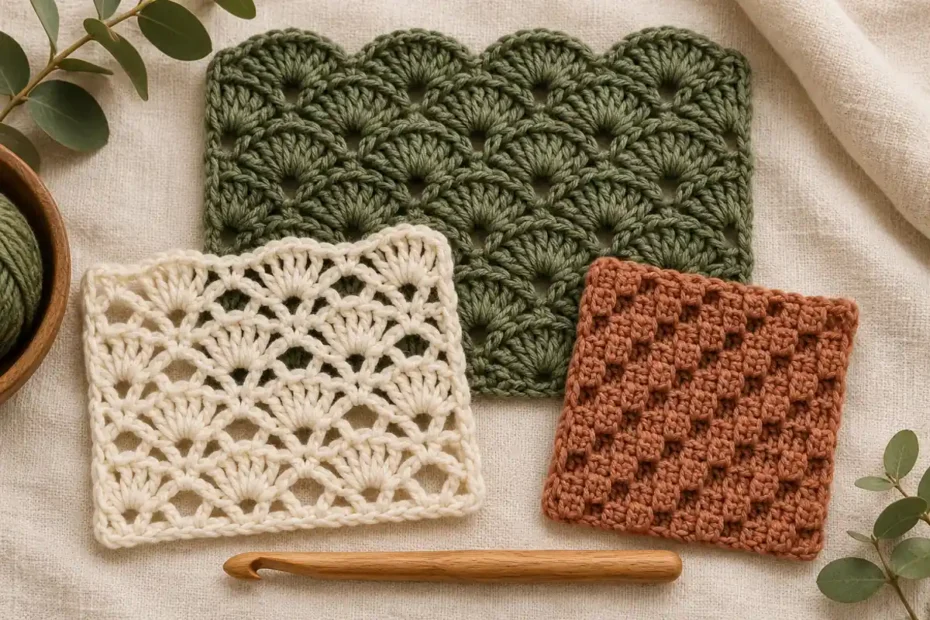
Crochet repeat charts show where a stitch begins, where it ends, and how it fits into the row. Five tall stems spreading from one point tell you where to work a shell. Crossed stems show a change in working order. An empty square needs a key to tell you what goes inside it.
The mini diagrams show one example of each chart cue. Use your pattern key for the full repeat and any variation in stitch count.
This guide covers 30 stitch patterns, from houndstooth and shells to cables, corner-to-corner blocks and filet mesh. Review Part 1 on basic crochet stitch symbols or Part 2 on textured crochet stitches.
Table of Contents
How to read crochet repeat charts
- Find the row or round number and follow the direction shown. Read the starting edge, repeat and ending edge separately.
- Trace each symbol down to a stitch top, a chain space or a post. Separate tops usually show separately finished stitches. Joined tops usually indicate a cluster or decrease.
- Compare with the row below. A group can sit inside a gap, reach a lower row or shift on alternate rows.
This guide uses US crochet terms. ch means chain, sl st slip stitch, sc single crochet, hdc half double crochet, dc double crochet and tr treble crochet. A chain commonly appears as an oval. A dc stem has one diagonal bar and a tr has two. Check the Craft Yarn Council symbol reference and follow the key for the version you are working.
Alternating stitches and raised textures
In crochet repeat charts for alternating stitches, compare the short and tall symbols with the row below before starting the next repeat.
61. Houndstooth stitch
Chart cue. Short sc and tall dc alternate, then shift on the next row.
How to read it. Work into the indicated stitch top, usually sc over dc and dc over sc. Follow the pattern’s colour changes.
62. Marshmallow stitch
Chart cue. Tall groups repeat beside short anchors in a textured version.
How to read it. Trace each stem to the charted base. Work shared-foot stitches together in one location and read short anchors separately.
63. Blackberry Salad stitch
Chart cue. A five-dc bobble has five unfinished legs gathered at one top.
How to read it. Work five partial dc in one marked base and close them as directed. Check whether the following row uses or skips a closure chain.
64. Almond stitch
Chart cue. Short slip stitches alternate with bands of taller stitches in a stepped ridge.
How to read it. Use the loop shown. In a back-loop ridge version, work back loop only where marked and follow the full row sequence.
When two crochet repeat charts use the same stitch name, start by comparing their stitch counts and hook placement. Names such as Marshmallow and Almond can refer to different versions. Check the key for group size, stitch height and loop placement.
Shells, fans, V-stitches and granny groups
Crochet repeat charts for shells and fans place the insertion point at the bottom of the group. The chain ovals show where openings form.
65. Shell stitch
Chart cue. Five dc stems can fan from one base with five separate tops.
How to read it. Work all five dc into the same stitch or space. Read adjacent skip and anchor symbols separately.
66. Open Shell stitch
Chart cue. Flared stems have one or more chain ovals between groups.
How to read it. For 2 dc, ch 1, 2 dc, all four dc go into the shared base. The chain makes the opening.
67. Fan stitch
Chart cue. Tall stems spread broadly, sometimes with chain ovals between them.
How to read it. Trace each foot. A shared foot uses one base. Separate feet use their indicated bases.
68. V-Stitch
Chart cue. Two tall stems spread from one base with a chain between their tops.
How to read it. Work dc, ch 1, dc in the marked base. If the next V points into the middle, insert the hook through that space.
69. Double V-Stitch
Chart cue. A common version has two stems on each side of a central chain.
How to read it. Work 2 dc, ch 1, 2 dc into the marked base for this version. Check the key for the chain count.
70. Granny Stitch
Chart cue. Three dc stems typically sit over one gap. Corners can show two groups and chains.
How to read it. Work each group into its indicated space. A corner can read 3 dc, ch 2, 3 dc in the same space.
71. Granny Stripe stitch
Chart cue. Rows of three-dc groups alternate between the lower row’s groups.
How to read it. Insert into the indicated gap or chain space. Read the first and last groups separately for straight edges.
Read one shell and one open shell
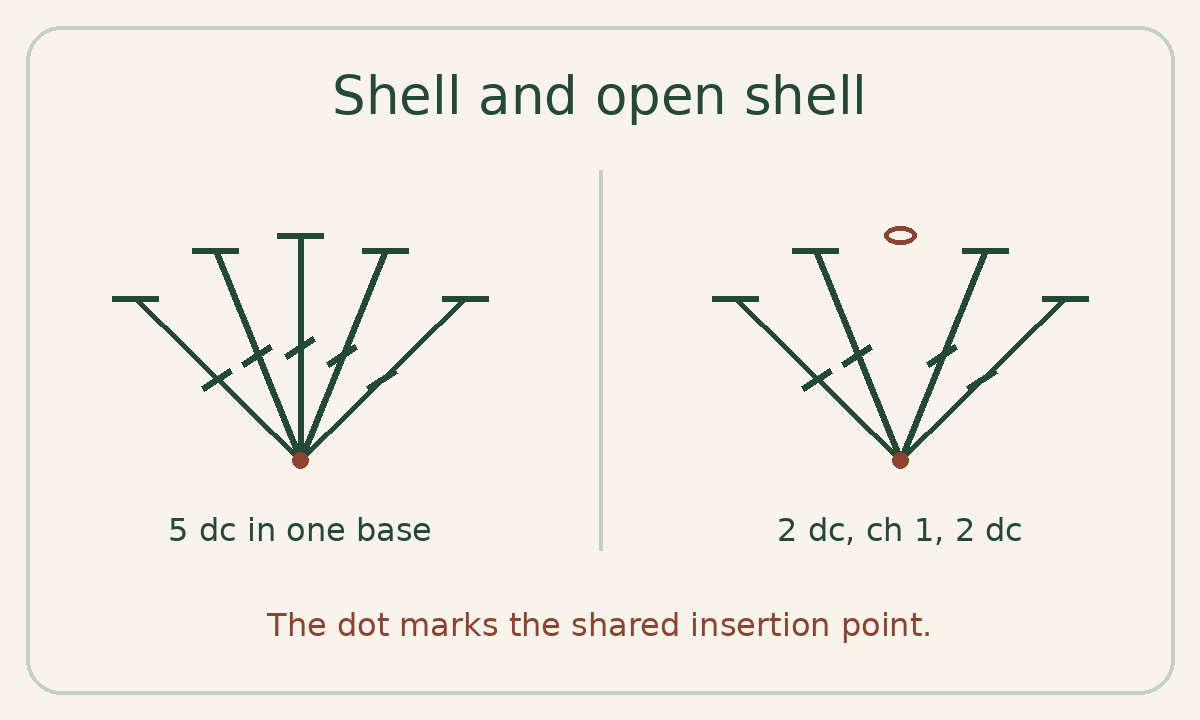
In these crochet repeat charts, the small dot gives you a fixed reference for the base. Five dc stems from one base produce five finished dc tops. An open shell of 2 dc, ch 1, 2 dc produces four dc tops and one ch-1 space. Insert through the opening if the next row points there.
Crossed stitches, cables and wheels
When crochet repeat charts show a crossing, trace both stems to their bases first. For cables, check the post placement as well.
72. Crossed Double Crochet
Chart cue. Two dc stems cross and end at separate bases.
How to read it. Skip A, work dc in B, then return to A for the second dc. Check whether the return stitch crosses in front or behind.
73. Crossed Treble stitch
Chart cue. Two crossing tall stems usually have two diagonal bars each.
How to read it. Work the forward tr at its marked base and return to the skipped position. Make any chains shown.
74. Crossed Cluster stitch
Chart cue. Bundles cross and may each have a joined top.
How to read it. Find each bundle’s start, closure and working order. Close any joined legs as the chart key directs.
75. Cable stitch
Chart cue. Tall post-stitch stems slant across neighbouring posts.
How to read it. Follow the stems around their marked posts. Check front- or back-post placement and read the crossing order.
76. Braided Cable stitch
Chart cue. Post-stitch groups cross in alternating directions over several rows.
How to read it. Follow the order and target posts for the current crossing. Work straight rows between crosses where shown.
77. Catherine’s Wheel stitch
Chart cue. An expanding fan alternates with a group gathered at one top.
How to read it. Work the fan’s separate stitches into the shared base. Gather the closing legs from the separate positions shown. Read half-wheels separately.
78. Bavarian stitch
Chart cue. Raised fans or diamonds build around previous groups, sometimes with joined post stitches.
How to read it. Trace each leg to its earlier stitch or post. Follow the specified front- or back-post placement and closure.
79. Harlequin stitch
Chart cue. An open shell can show 3 dc, ch 1, 3 dc, with six closing legs in the next section.
How to read it. Work the open shell in the marked base. Gather each leg from its shown position and check edge groups separately.
Follow a two-stitch cross
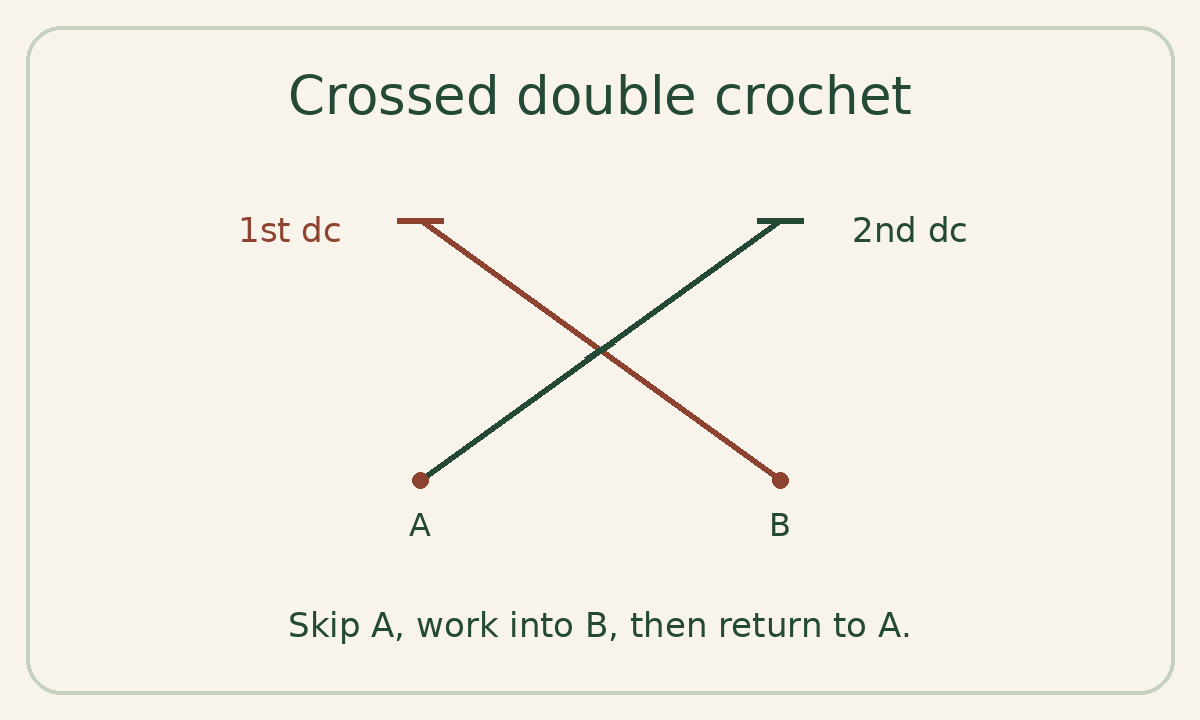
Across crochet repeat charts, the diagonal bar identifies the stitch height while the crossed stems identify its placement. Label the next two bases A and B in working order. Skip A, work into B and return to A. For cables, trace each stem to the post it wraps around.
Arches, bricks, blocks and scales
Crochet repeat charts for blocks can show a group of stitches or one square per tile. Check the key before counting.
80. Arcade stitch
Chart cue. Repeated arches or fans have short anchors between them.
How to read it. Put the arch or fan into the marked space. Follow the short anchor’s own symbol and check where the next repeat attaches.
81. Brick stitch
Chart cue. Offset groups resemble bricks. Overlay versions can have stems reaching into lower rows.
How to read it. Use the marked base for each stem. A long stem can reach below the previous row to the exact stitch shown.
82. Block stitch
Chart cue. Solid dc groups alternate with a spacer row of anchors and chains.
How to read it. Work the sc anchors and chains on the spacer row. Work the dc group into the indicated space on the block row.
83. Crocodile stitch
Chart cue. A scale spreads around two support posts.
How to read it. Work one side around each post, rotating the work as directed. Check centre chains and any skipped support pairs.
84. C2C Block
Chart cue. A stitch diagram shows tall stitches and chains. A grid square stands for one whole tile.
How to read it. In a common dc tile, join at the neighbouring ch-3 space, then work ch 3 and 3 dc in that space as directed. Count tiles diagonally.
Count C2C tiles by diagonal
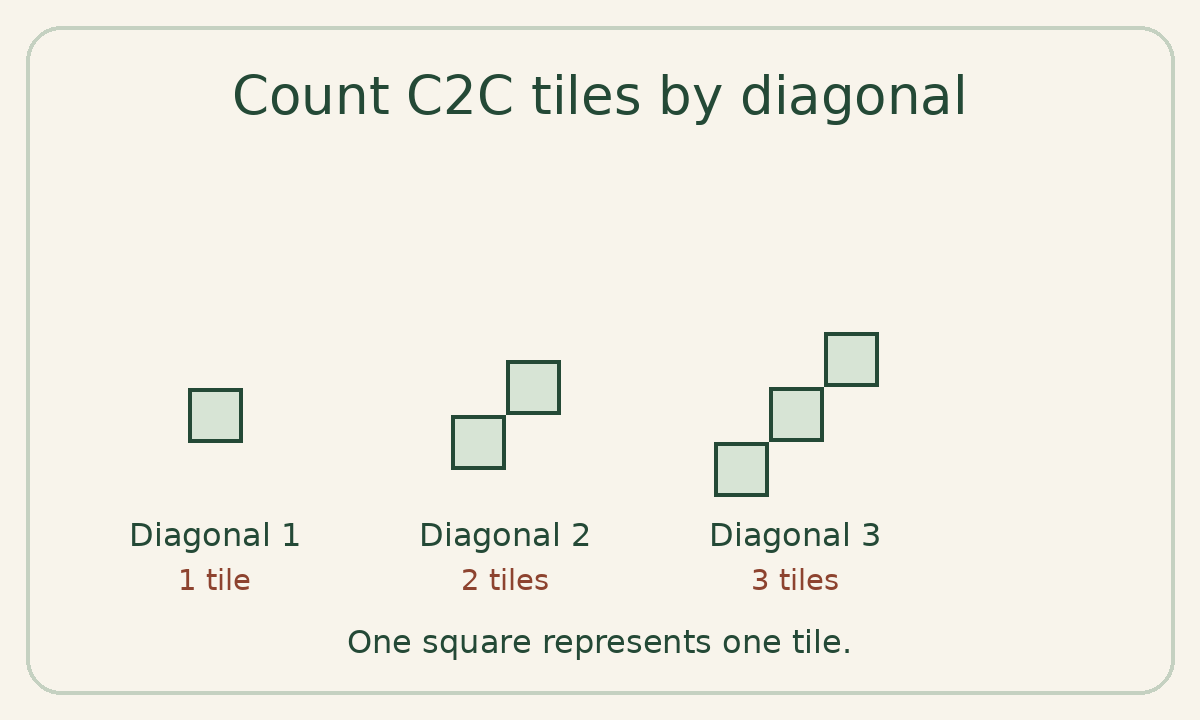
C2C crochet repeat charts use the diagonal as the counting unit for a row of tiles. A growing corner with diagonals of 1, 2 and 3 tiles has six completed tiles. Use the edge instructions to see when the next diagonal increases or decreases.
Mesh, trellis and spider lace
In crochet repeat charts for lace, follow the chain arches across several rows to see where each opening starts and closes.
85. Chain Mesh
Chart cue. Chain ovals form arches between short anchors.
How to read it. Make the stated chain count, then anchor in the stitch or space shown. Work around the arch where the symbol points into the space.
86. Double Crochet Mesh
Chart cue. Dc posts stand between chain ovals, forming open squares or rectangles.
How to read it. Make the chains, skip the marked base positions and work the next dc at its indicated base.
87. Filet Crochet Mesh
Chart cue. A grid uses open and filled squares. Detailed charts show chains and posts.
How to read it. In a common three-position system, an open cell adds ch 2 and dc after the boundary. A filled cell adds 3 dc. Neighbours share a boundary post.
88. Diamond Mesh
Chart cue. Chain arches and anchors shift to form diagonal edges around openings.
How to read it. Track each anchor relative to arches below. Read multiple rows to see the full diamond.
89. Trellis stitch
Chart cue. Staggered chain arches form a lattice, sometimes with groups at joining points.
How to read it. Count chains and follow each anchor. Read partial arches at the edges separately.
90. Spider stitch
Chart cue. In lace, chain arches spread around a compact centre.
How to read it. Trace the arches and work centre stitches where shown. For the dense sc, ch 1, sc version, follow the chart’s short groups and chain spaces.
Count two filet squares
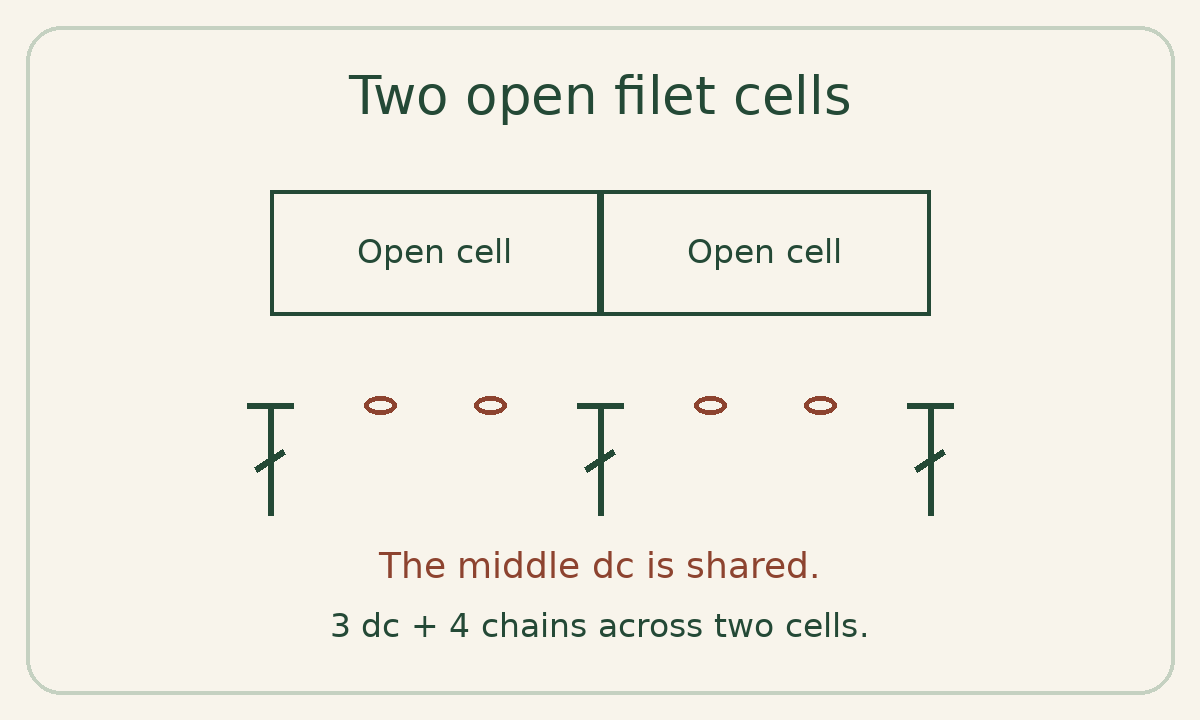
Filet crochet repeat charts let adjacent cells share one upright post. Two cells span seven positions in the three-position system. Two open cells read dc, ch 2, dc, ch 2, dc. An open cell followed by a filled cell uses five dc and two chains. Two filled cells use seven dc. Check whether the turning chain replaces the first dc.
Check the stitch count in crochet repeat charts
Work one marked repeat with the edge stitches shown. Count the base positions used, then count the finished stitch tops and spaces. Compare the next starting point with the row below. A repeated unit in crochet repeat charts can be an individual stitch, a shell, a filet cell or a C2C tile.
Frequently asked questions
What does a shared base mean in crochet repeat charts?
They usually go into the same stitch or space. A five-dc shell uses one base and finishes with five separate tops.
What does a joined top mean in crochet repeat charts?
They are generally worked together. A bobble can have one base, while a decrease can take legs from several different stitches.
Why do shell symbols vary across crochet repeat charts?
Check the stitch height, number of stems and chain placement. These details show which version to work.
How do crochet repeat charts mark a chain space?
Follow the symbol and written instructions. Work through the opening for a chain space. Pick up the indicated individual chain when the pattern names a specific chain.
Do crochet repeat charts include turning chains in the repeat?
Follow the repeat marks. The first chain, edge group or partial shell may be outside the repeated section and worked once.
How do crochet repeat charts for filet and C2C use squares?
A filet square is an open or filled cell built from posts and chains. A C2C square is one tile worked along a diagonal. Check the grid key before counting either one.