Use this free crochet hook size converter to compare metric diameters with common US letters and traditional UK numbers. Select the size marked on your regular yarn hook, then read its reference labels. Millimetres are the most useful final check because a letter or number can mean different sizes on different brands.
Mehroosh Crochet Co · Free crochet tools
Compare millimetres with common US and traditional UK hook labels.
Reference chart
Use the millimetre diameter as the final reference. US letters and old UK numbers vary between brands and vintage charts. A dash means no equivalent is listed here. This tool covers regular yarn hooks, not steel thread hooks; do not apply its labels to steel hooks.
| Metric (mm) | Common US label | Traditional UK label |
|---|---|---|
| 2.0 | — | 14 |
| 2.25 | B-1 | 13 |
| 2.5 | — | 12 |
| 2.75 | C-2 | — |
| 3.0 | — | 11 |
| 3.25 | D-3 | 10 |
| 3.5 | E-4 | 9 |
| 3.75 | F-5 | — |
| 4.0 | G-6 | 8 |
| 4.5 | 7 | 7 |
| 5.0 | H-8 | 6 |
| 5.5 | I-9 | 5 |
| 6.0 | J-10 | 4 |
| 6.5 | K-10½ | 3 |
| 7.0 | — | 2 |
| 8.0 | L-11 | 0 |
| 9.0 | M/N-13 | 00 |
| 10.0 | N/P-15 | 000 |
Table of Contents
How to use the crochet hook size converter
First, find the size printed on the hook or its packaging. Check whether it is a metric measurement, a US letter, or an older UK number. Choose the matching entry in the list and select Convert. The result shows the metric size and the two label systems side by side.
If the label is worn away, compare the hook with its manufacturer’s sizing information or use a suitable hook gauge. Do not identify a diameter from the colour of the handle. A brand may reuse a handle colour across different ranges, and decorative handles do not tell you the shaft size.
A crochet hook size converter example: 5 mm
A regular 5 mm yarn hook is commonly labelled US H-8 and traditional UK 6. The number eight in the US label is not a measurement of eight millimetres. Likewise, old UK 6 does not mean six millimetres. Keep the full label with its system when recording your project notes.
Another entry, 4 mm, is commonly US G-6 and traditional UK 8. This illustrates why the bare number six is ambiguous: it can appear in labels for different metric sizes. The crochet hook size converter keeps the systems separate so you can compare the information without treating those numbers as equivalent measurements.
Why metric size comes first
The Craft Yarn Council’s hook-size reference explains that letters and numbers vary between manufacturers. Use the millimetre size on your actual hook as the final reference. A dash in this tool means no equivalent is listed; it does not mean that the metric hook is unavailable.
This chart covers a selection of regular yarn hooks from 2 mm to 10 mm. It is not a complete catalogue of every manufacturer or vintage system. Steel thread hooks use other sizing conventions and are excluded. Do not use the traditional UK column as a steel-hook conversion chart.
Check gauge after changing hooks
Matching a hook label is only one part of matching a pattern. Yarn, stitch texture and your tension affect the size of the fabric. Make a sample in the intended stitch pattern, follow its finishing instructions and compare the finished gauge with the designer’s requirements.
If you substitute a hook, keep a note of its metric size and the resulting gauge. Our stitch-counting guide can help with measuring the sample. Then use the Crochet Stitch Calculator to estimate working stitches for a straight panel. Changing the stitch count does not redesign garment shaping.
Crochet hook size converter questions
Does the same letter always mean the same diameter? No. Check the millimetre marking and the manufacturer’s information, particularly when following a vintage pattern or replacing a hook from another brand. The result is a reference comparison, not a certification of an unmarked hook.
Can I convert knitting needles with this chart? No. This is a crochet hook reference. Needle labels and steel crochet hook labels should be checked against charts intended for those tools.
Will a larger hook always fix my project size? Recheck your gauge and pattern before changing equipment. A different hook can alter both size and fabric feel. Explore our crochet tutorials for stitch practice or return to the free crochet tools hub for project planning.
When you find a comfortable match, record the brand and metric diameter with your sample measurements so the project is easier to resume.
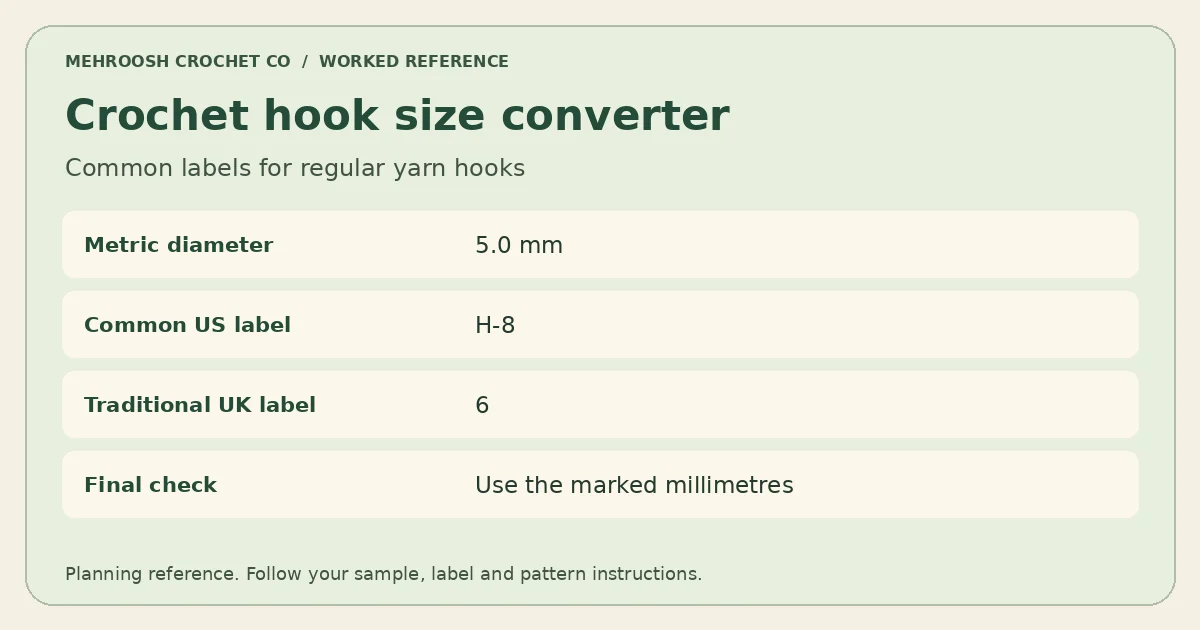
Three checks after using the crochet hook size converter
1. Keep the complete size label
Write the metric diameter first, followed by the source label exactly as printed. For example, a note reading 5 mm, US H-8 gives more information than a note reading size eight. Add the brand or range when it helps you identify the actual hook. If you later replace it, the recorded gauge remains a useful comparison alongside the label.
The crochet hook size converter provides reference equivalents for ordinary yarn hooks. An apparently similar number on a steel thread hook belongs to a different system. When a pattern requests a size outside the displayed selection, check the designer and manufacturer rather than choosing the nearest entry without checking the difference.
2. Compare fabric, not only equipment
Make the same stitch sample with the replacement hook and your chosen yarn. Use the same measurement method and finishing process for both samples. Compare stitch width, row height and whether the fabric feels suitable for its intended purpose. Matching width while producing a much taller row may still affect a fitted design or a textured repeat.
A crochet hook size converter cannot account for the shape of a hook head, the length of its throat or the way you hold it. These details can affect comfort and how you form stitches. Note the hook you actually used instead of assuming every tool with an equivalent label will feel identical.
3. Recheck before changing the project plan
If the finished sample differs from the pattern, first confirm the stitch, measurement area and count. Then assess a different hook using the designer’s gauge advice. Do not change both yarn and hook at the same time unless you are prepared to make and measure another sample; otherwise it becomes difficult to identify the effect of each change.
Use the crochet hook size converter to organise the size comparison, then keep the swatch result with your project notes. For an unrestricted rectangular panel, the stitch calculator can compare counts at the measured gauge. For clothing, follow the pattern’s sizing and shaping instructions rather than treating a width calculation as a replacement for the design.
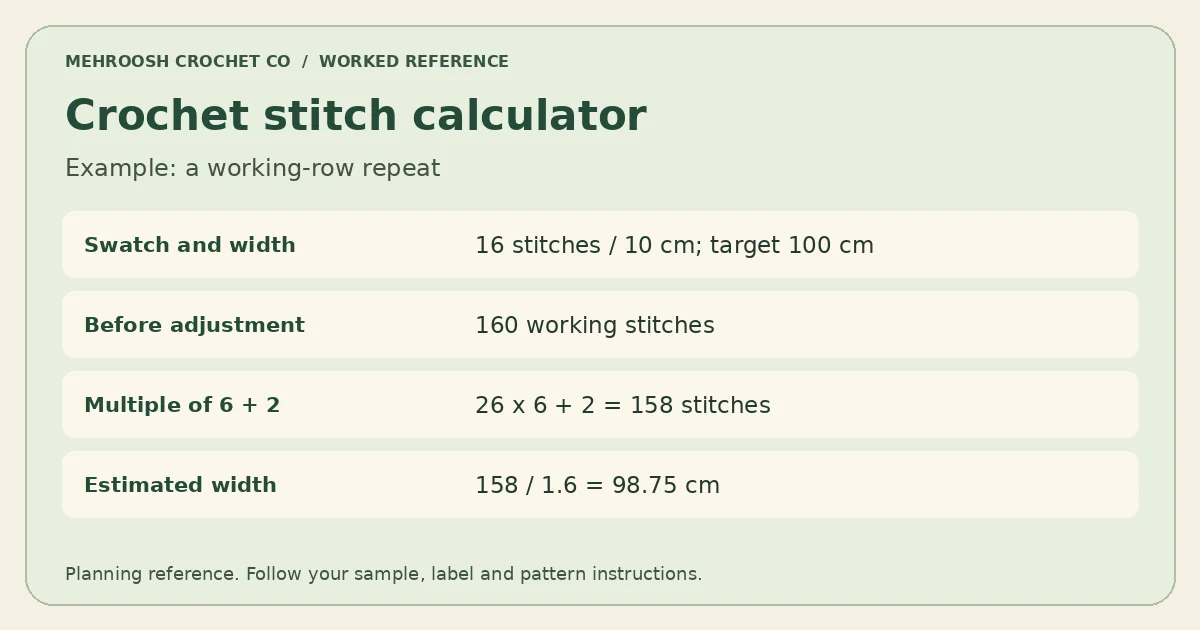 Crochet Stitch Calculator
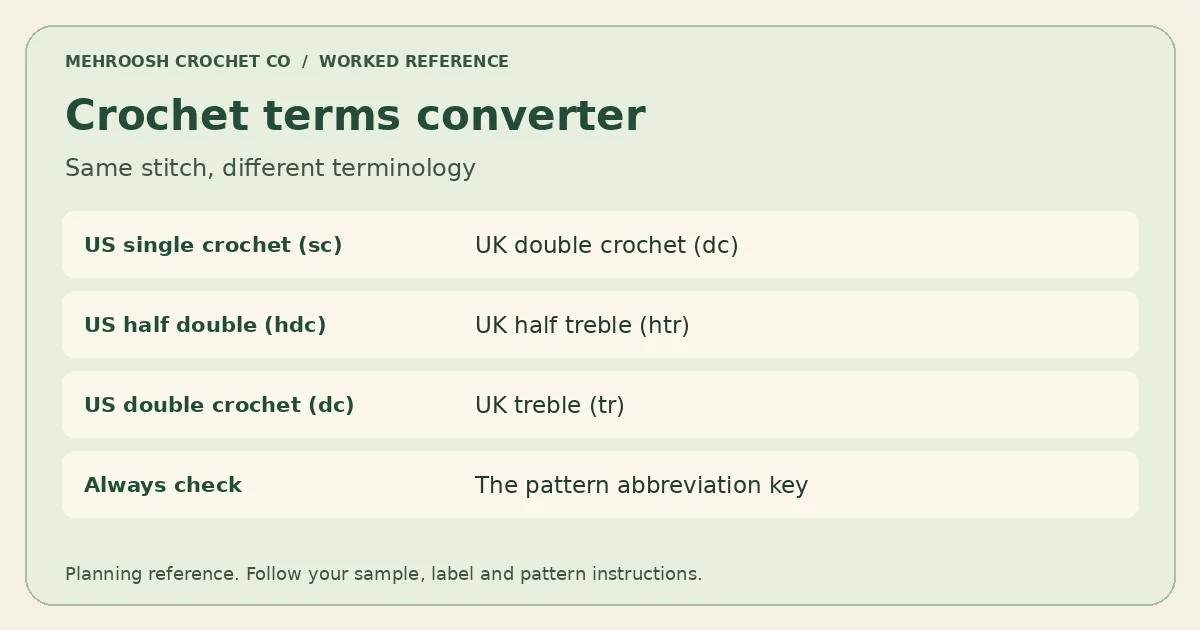 US to UK Crochet Terms Converter
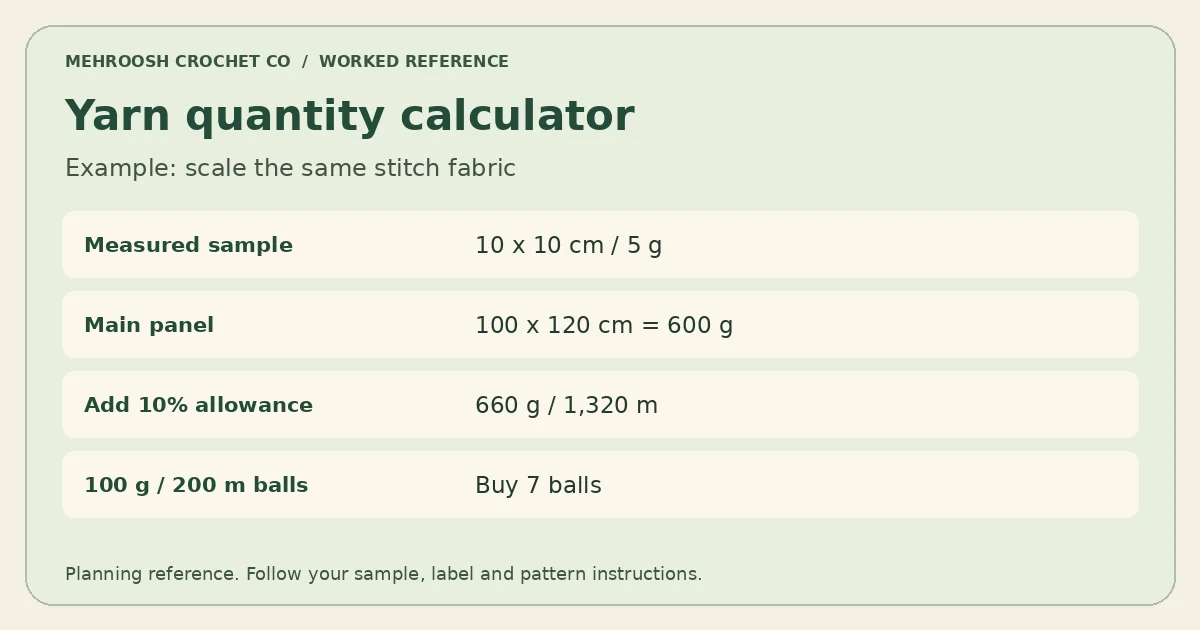 Yarn Quantity Calculator