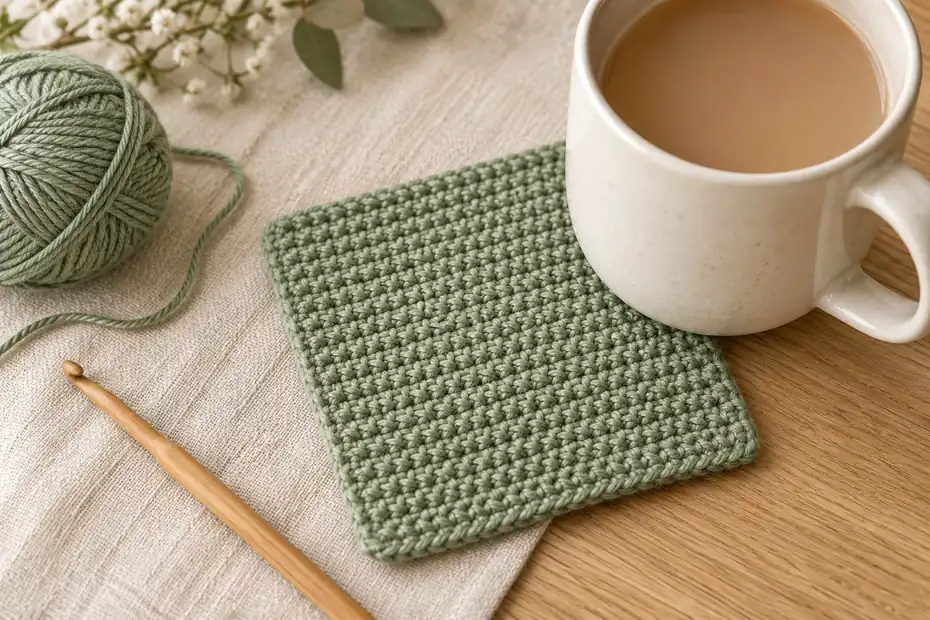
Images are AI-generated project illustrations. Follow the written stitch counts and measure your own work.
Make a square crochet coaster using single crochet worked back and forth. This small project practises finding the first and last stitch, keeping a consistent count and finishing yarn ends. There is no border in this version.
Before You Start This Square Crochet Coaster
- Skill level: Beginner project using chains and single crochet.
- Terminology: US crochet terms. US single crochet is called double crochet in UK terminology.
- Construction: A flat panel, worked in rows, with 20 stitches in every row.
- Finished size: Adjustable. The width depends on your yarn, hook and stitch gauge. Work until the height matches the width; the number of rows depends on your row gauge.
- Gauge: A specific gauge is not required for this measure-as-you-go project. Check the width after a few rows and make sure it suits the intended cup or mug. To change the width, follow the adjustment instructions below.
If you are new to these movements, read our How to Crochet guide first.
Materials for a Square Crochet Coaster
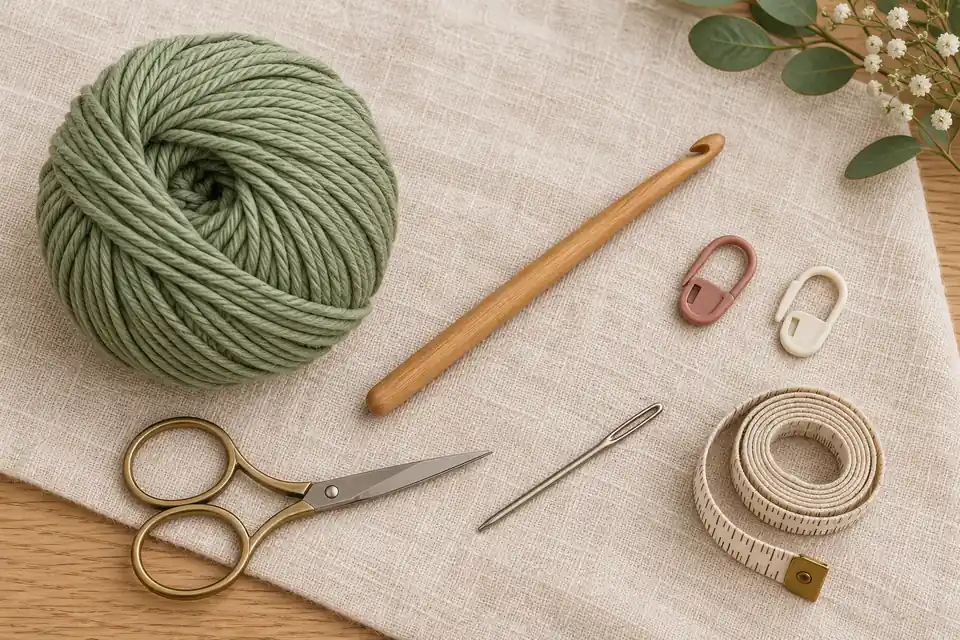
- Smooth, medium-weight cotton yarn, preferably in a light colour so the stitches are easy to see. Yarn use varies with the finished dimensions, yarn and tension; keep enough of the same yarn available to complete the square.
- A crochet hook suitable for the yarn. Use the yarn label’s recommended range as a starting point and check the resulting fabric.
- Two removable stitch markers.
- Scissors, a yarn needle and a ruler or measuring tape.
For a square crochet coaster, choose fabric that is firm enough to hold its shape while lying flat. Use this project as a drinks coaster, not as a potholder or a mat for cookware.
Abbreviations
| Abbreviation | Meaning |
|---|---|
| ch | Chain |
| sc | Single crochet |
| st / sts | Stitch / stitches |
These abbreviations follow the Craft Yarn Council’s US terminology.
Square Crochet Coaster Pattern Notes
- The live loop on the hook does not count as a chain or stitch.
- The ch 1 made before turning does not count as a stitch.
- Do not crochet into the turning chain.
- From Row 2 onward, work under both top loops of each single crochet stitch.
- Count 20 sc after every row. Keep a marker in the first and last stitch and move each marker into the corresponding new stitch as you work.
- The instructions describe right-handed work. Left-handed makers can mirror the working direction without changing the counts.
Foundation
Make a slip knot, leaving a tail of about 15 cm / 6 in for weaving in. Ch 21. Keep the chain relaxed enough to insert the hook without forcing it.
Row 1
With the chain’s V shapes facing you, skip the first chain beside the hook. Insert the hook under the upper strand of the second chain from the hook and make 1 sc.
Place a marker through both top loops of that completed stitch, leaving the live hook loop unmarked. Make 1 sc in each remaining chain, using the same insertion method across the foundation. Mark the last completed stitch.
Count: 20 sc. You used 20 of the 21 chains; the skipped chain does not add a stitch.
Row 2
Ch 1 and turn. Find the marked stitch immediately beside the hook: this was the last stitch you made in the previous row and is now the first stitch to work into. Remove its marker, make 1 sc under both top loops, and place the marker in the new stitch.
Make 1 sc in each of the next 19 stitches. The marked stitch at the far edge is the final one to work into. Remove that marker before working the stitch, then place it in the new last stitch. Do not work into the turning chain.
Count: 20 sc.
Row 3 and following rows
Continue your square crochet coaster by repeating Row 2, keeping 20 sc in every row.
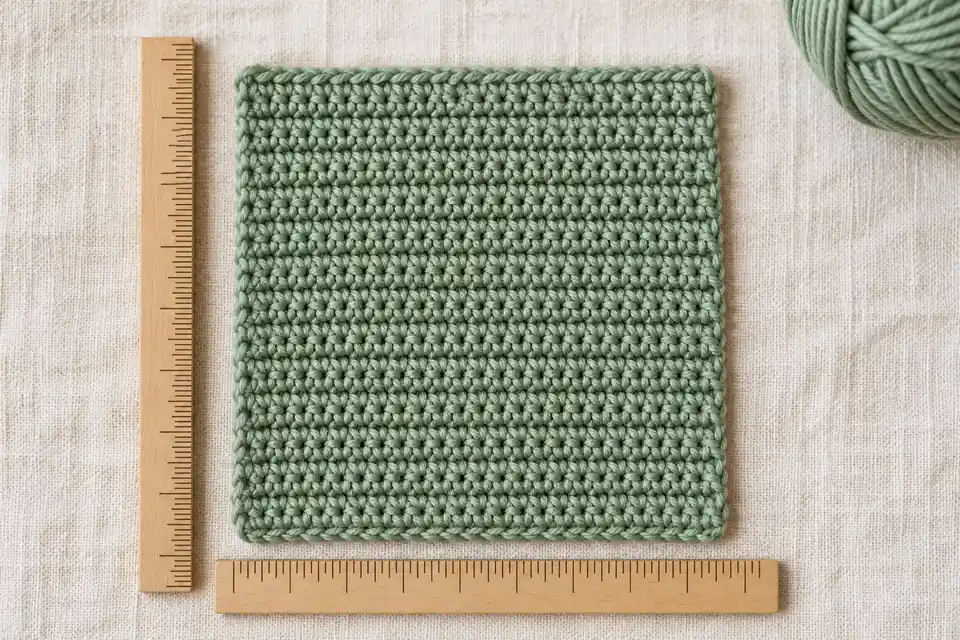
After several rows, lay the work flat without stretching. Measure the width across the panel and the height from the foundation edge to the top of the latest completed row. Continue until the height is as close as possible to the width, stopping at the end of a complete row.
Do not assume 20 rows will make a square. Stitch width and row height are different. Let the measurements determine when to stop. Record the total number of rows you actually make, including Row 1. The foundation chain is not a separate row.
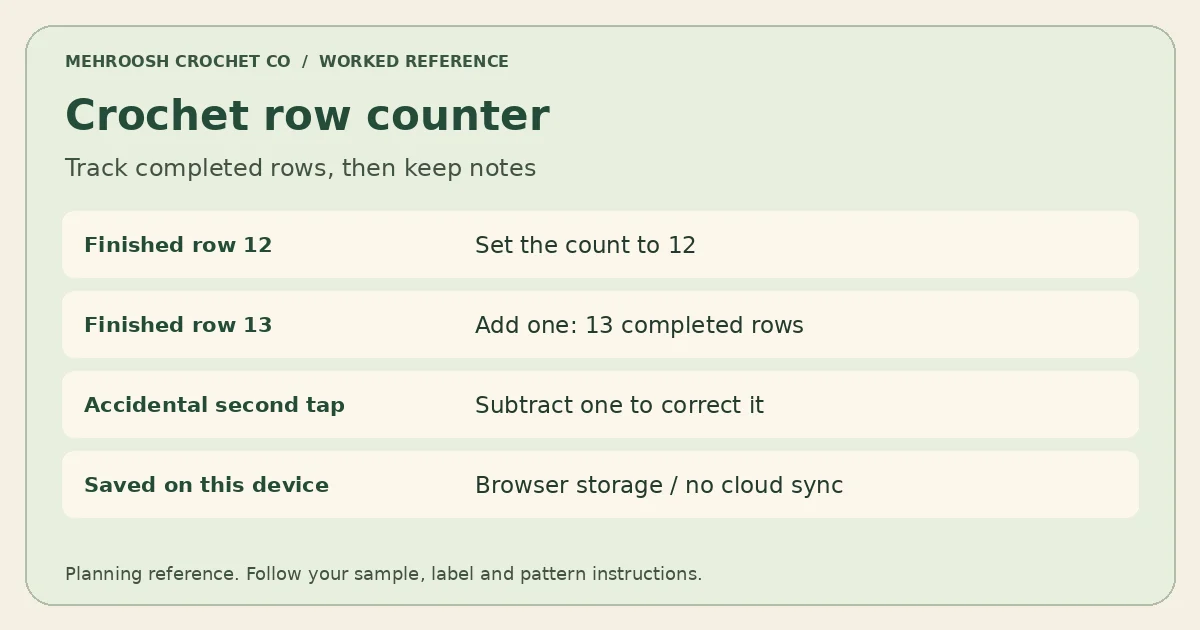
Use our Crochet Row Counter to record completed rows. Check the stitches in each row separately.
Finish Your Square Crochet Coaster
After the last sc, cut the yarn with a tail of about 15 cm / 6 in. Draw the cut end completely through the live loop and gently tighten it. Remove the markers.
Thread the tail onto a yarn needle and weave it through several stitches within the fabric, keeping the edge relaxed. Change direction through a nearby path to help secure it, then trim the spare end. Weave in the starting tail too.
Follow the yarn label’s care instructions. If washing or blocking, shape the piece gently and let it dry flat without pulling it into a size it cannot naturally hold. Measure again when fully dry. Check that the coaster lies flat and comfortably supports the intended cup or mug.
Record the yarn, hook, completed rows and finished measurements of your square crochet coaster so you can make another to match.
If the shape looks wrong
- The sides slope inward: Check for a missed first or last stitch. Each row must contain 20 sc.
- The panel gets wider: Check for two stitches worked into one stitch, or an accidental stitch in the turning chain.
- The foundation edge pulls inward: The starting chain may be too tight. Restart with a more relaxed chain and compare the edges.
- The panel is rectangular: Measure it. Add or remove complete rows to bring the height closer to the width.
- The finished coaster does not lie flat: Recheck the stitch counts and tension. Do not rely on stretching to hide a construction error.
Adjust the Square Crochet Coaster Width
To change the width of your square crochet coaster, choose a new working stitch count and make one more foundation chain than that count. For example, 23 chains produce 22 sc when you skip the first chain and work into the remaining 22 chains. Keep the new stitch count in every row, and again work until the height matches the width.
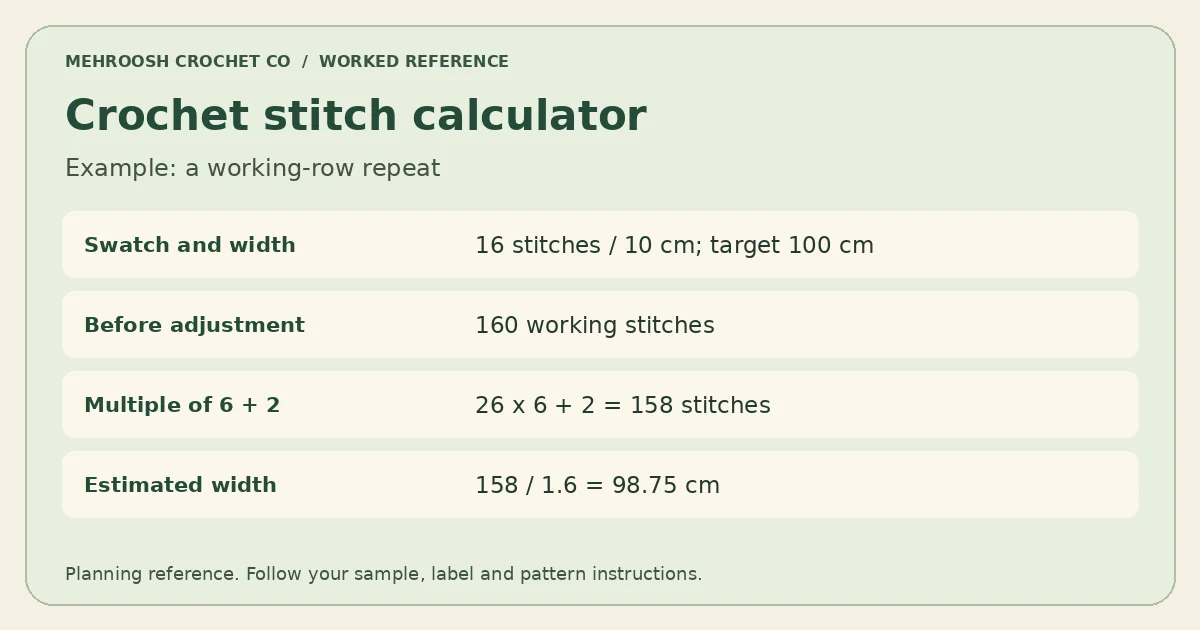
For a more deliberate size estimate, measure your own sample and use our Crochet Stitch Calculator. Its result is a working-row count; add the one skipped foundation chain for this particular pattern.
Find your next project in our free crochet patterns collection.
Tools for Your Next Planning Step
Use these references with your own measurements and the written instructions above.
 Crochet Stitch Calculator
 Crochet Row Counter
Make a Matching Square Crochet Coaster Set
Keep one finished piece as the reference
Finish the first square crochet coaster before using it as your size reference. If you wash or block it, follow the yarn label and let it dry completely before measuring. Keep the yarn name, hook size, working stitch count and actual completed row count together. Compare the second piece with that record rather than trying to match an illustration.
Check width before adding many rows
Lay the new fabric flat after a few rows and compare its width with the first coaster. If the width differs, recount the stitches and check the yarn, hook and tension. Adding more rows changes the height; it does not correct a width difference. Find the reason while the piece is still short enough to rework easily.
For a matching square crochet coaster, keep the chosen stitch count constant across every row. Continue measuring height against width as described in the pattern. Your earlier row total is a useful comparison, but the new piece’s measurements still determine when to finish. A different tension can change the number of rows needed.
Compare colours with a small sample
If your set uses several colours, check the label information and the finished fabric rather than relying on colour alone. Yarns that look similar can behave differently. Keep a small sample when changing materials, and compare its feel, width and ability to lie flat before making the whole set.
Check the finished piece for its intended use
Place the finished square crochet coaster on a flat surface and compare it with the base of the intended cup or mug. The fabric should lie flat rather than rocking on a curled edge. Inspect the woven ends and remove any remaining markers. Follow the care instructions for the actual yarn when cleaning the set.
This square crochet coaster is a small fabric project for drinks. Keep the existing use guidance in mind: it is not a potholder or a mat for hot cookware. A matching set is a chance to practise consistent stitches and measurements while keeping the same written construction.