Estimate your working stitch count
Mehroosh Crochet Co · Free crochet tools
Use this free crochet stitch calculator to estimate the working stitches for a blanket, scarf or another straight piece. Enter your own swatch gauge and project width, then adjust for pattern repeats if needed.
Your next row starts here.
Enter the gauge from the yarn, hook and stitch pattern you plan to use. Then calculate your stitch count.
Stitches ÷ measured width × desired width
Your working stitch count
160
stitches across the working row
- Estimated width, rounded
- Difference from target
- Your measured gauge
- Repeat breakdown
Before making your starting chain: this is a working-row count. Follow your pattern to determine starting chains, turning chains, and whether a beginning chain counts as a stitch.
Repeat adjustment uses the average width per stitch in your swatch. Extra edge stitches may have a different width. Measure a full-repeat sample and check the finished width before starting a large project.
16 stitches across 10 cm gives 1.6 stitches per cm. For a width of 100 cm, the starting estimate is 160 working stitches.
Measure a swatch in your chosen stitch pattern, after any blocking required by the pattern. Actual size can change with tension and finishing. This calculator estimates width; it does not estimate yarn quantity or design shaping.
Find your stitch tops
Learn to count stitches and mark the edges before measuring.
Choose a blanket stitch
Explore fabric styles, then swatch your chosen stitch.
Try a free pattern
Put your skills into practice with a small project.
Table of Contents
How to use the crochet stitch calculator
- Choose centimeters or inches. Use the same unit for your measured swatch section and the width you want to make. Switching units converts both width fields.
- Count stitches across your swatch. Enter the number of working stitches inside the section you measured. Do not count the live loop on your hook as another completed stitch.
- Enter that section’s width. If you counted 16 stitches across 10 cm, enter 16 and 10. You can use a different measured width; it does not have to be exactly 10 cm.
- Set your desired project width. For a scarf worked across its narrow edge, use the scarf width. For a blanket worked across a full row, use the width of that row before any separate border.
- Apply a repeat rule if required. Open the pattern options, enter the working-row multiple and extras, and select a rounding direction. Press Calculate stitches to compare the count with its estimated width.
Measure a swatch before choosing your stitch count
Work a sample with the yarn, hook and stitch pattern intended for your project. Make it large enough to measure a section away from the edges. Lay it flat without stretching it and follow the pattern’s washing or blocking instructions before taking the measurement.
Gauge is personal: a yarn label or another maker’s sample cannot tell you exactly how wide your stitches will be. If you change the hook, yarn or stitch pattern, measure another sample. Our guide to counting crochet stitches can help you identify the stitches inside your measured section.
The Craft Yarn Council also explains why a sample matters in its gauge and pattern-reading guidance. For fitted garments, follow the designer’s gauge and sizing instructions; changing a row count alone does not preserve shaping or fit.
Stitch multiples: a worked blanket example
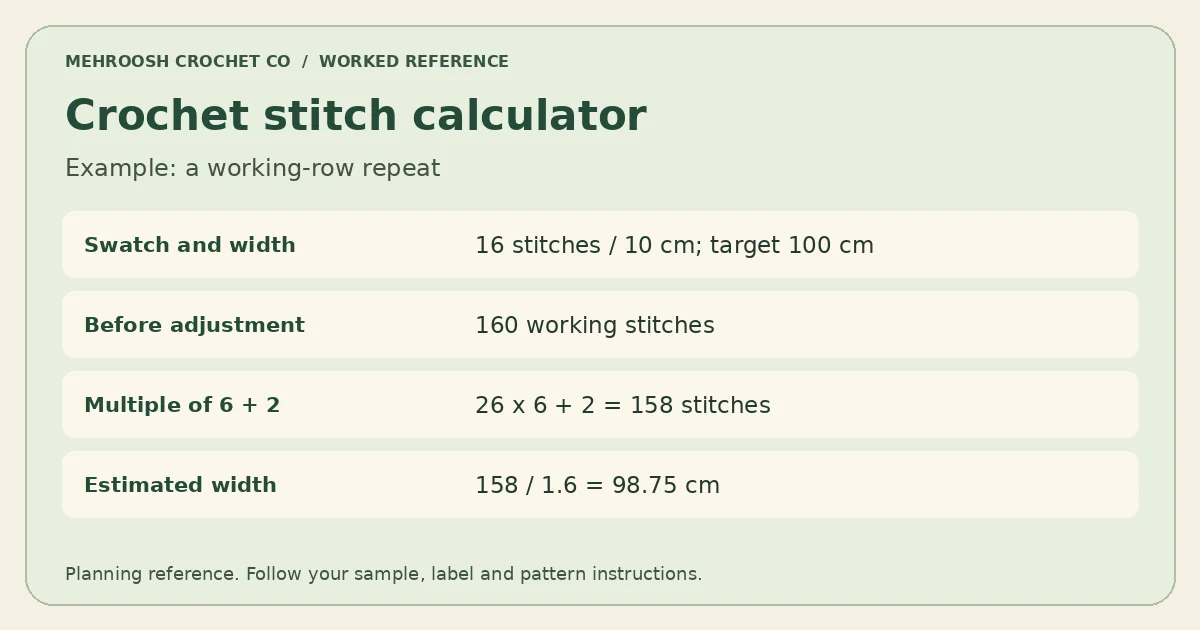
The crochet stitch calculator first divides the counted stitches by the measured width, then multiplies by the target width. With 16 stitches across 10 cm and a target of 100 cm, the unadjusted result is 160 stitches.
Suppose the working row requires a multiple of 6 plus 2 extra stitches. The closest valid count is 158 stitches: 26 repeats × 6 + 2. At the sample gauge, this estimates a width of 98.75 cm. Rounding up gives 164 stitches, estimating 102.5 cm. Choose the option that suits your project, then check it with a sample.
The extra stitches are added once to the entire row. They are not added to every repeat. A rule printed for a foundation chain may include turning chains or skipped chains, so it cannot automatically be used as a working-row rule. If the wording is unclear, check our crochet pattern-reading guide before entering the multiple.
Crochet stitch calculator questions
Does the result tell me how many chains to make?
No. The result counts stitches across the working row. Starting chains depend on the stitch and the pattern’s turning-chain convention. Use the pattern to convert the working count into a foundation chain, including any chains that count as stitches.
Can I use it for any crochet stitch?
Use a swatch in the same stitch pattern as the finished piece. For shells, lace or other grouped stitches, count consistently and measure complete repeats where possible. This tool uses an average width per stitch; unusual edge stitches may need a separate width allowance.
Will the finished width be exact?
The result is an estimate based on your sample. Tension, blocking and the weight of a larger piece can change the width. Check the first few rows before continuing. The tool does not calculate row counts, yarn quantity, increases, decreases or garment shaping.
What if no repeat fits below my target?
Round down cannot return a valid row when even one full repeat plus the extras exceeds your target. Increase the width, revise the repeat rule, or choose another rounding option. The calculator will explain when it uses the smallest valid count.
Crochet stitch calculator: compare three planning decisions
Check the measured section
The crochet stitch calculator needs a stitch count and the distance occupied by that same count. Suppose you count eighteen stitches across a flat nine-centimetre section. Enter eighteen and nine together. Entering eighteen with a ten-centimetre distance would describe a different gauge, even if ten centimetres is the reference used by the pattern.
Measure away from the edge where possible and count complete stitches using a consistent convention. If an edge stitch differs in width, note that limitation. The crochet stitch calculator uses an average width per stitch; it cannot identify a decorative edge or adjust a special stitch automatically.
Compare permitted counts
At eighteen stitches over nine centimetres, a thirty-centimetre width gives sixty unrestricted working stitches. A working-row rule of four stitches plus one extra permits fifty-seven or sixty-one around that target. Those counts estimate twenty-eight and a half or thirty and a half centimetres at the same sample gauge.
The crochet stitch calculator lets you compare a rounding direction, but the suitable choice depends on the project. A narrow scarf may tolerate a small difference that a fitted panel cannot. Record the selected count and its estimated width together instead of keeping only the stitch number.
Keep the starting chain separate
Read the designer’s foundation instructions after using the crochet stitch calculator. A working-row count does not say which chain receives the first stitch or whether a turning chain counts. For a simple single-crochet exercise where the first chain is skipped and the turning chain does not count, sixty working stitches would normally follow sixty-one starting chains. That example is not a rule for other stitch patterns.
When a printed repeat refers to chains rather than working stitches, establish the relationship before entering it. If the relationship is unclear, consult the designer or the written stitch instructions. Use the crochet stitch calculator as a width-planning aid, then check the first rows against both the count and the measurement before continuing.
 Blanket Size Calculator
 Crochet Hook Size Converter
 Yarn Quantity Calculator