Use this free blanket size calculator to plan the working stitches and rows for a rectangular crochet blanket. Start with measurements from your own swatch, then compare the estimate with the size you want to make. The result helps you plan a straight piece; your pattern still supplies the starting chain, borders and any shaping.
Mehroosh Crochet Co · Free crochet tools
Estimate stitches and rows for a rectangular blanket using your own stitch and row gauge.
Your estimate
Enter your details, then select Calculate.
This estimates a rectangular piece worked in straight rows. The stitch count is for the working row, not the starting chain. Turning chains, separate borders, motifs and shaping need the pattern's own instructions.
How this blanket size calculator works
Measure both stitch and row gauge in the stitch pattern you will use. A repeat multiple adjusts the stitch count, while rows are rounded individually. If your design also needs a row repeat, adjust the row count according to that pattern. Check the first few rows against the estimated finished width.
For help with gauge, visit our stitch-counting guide. Explore all crochet tools or browse free patterns.
Table of Contents
How to use the blanket size calculator
- Choose one measurement system. Enter all fabric dimensions in centimeters or inches. Switching the unit converts the width and length fields; it does not change the physical size you entered.
- Measure your intended fabric. Count stitches across a flat section of your swatch and rows up another measured section. Record the actual measured distances, even when the section is slightly wider than 10 cm.
- Set the blanket dimensions. Use the width and length of the main fabric. If a border will be added separately, decide its width first and leave that space outside the calculated panel.
- Check the repeat rule. Enter a working-row stitch multiple and any extra stitches added once to the row. Keep the multiple at one and extras at zero for an unrestricted stitch count.
- Calculate and compare. Read both the stitch count and estimated dimensions. Choose the closest estimate, round up or round down according to the space available.
A blanket size calculator example: 160 stitches and 144 rows
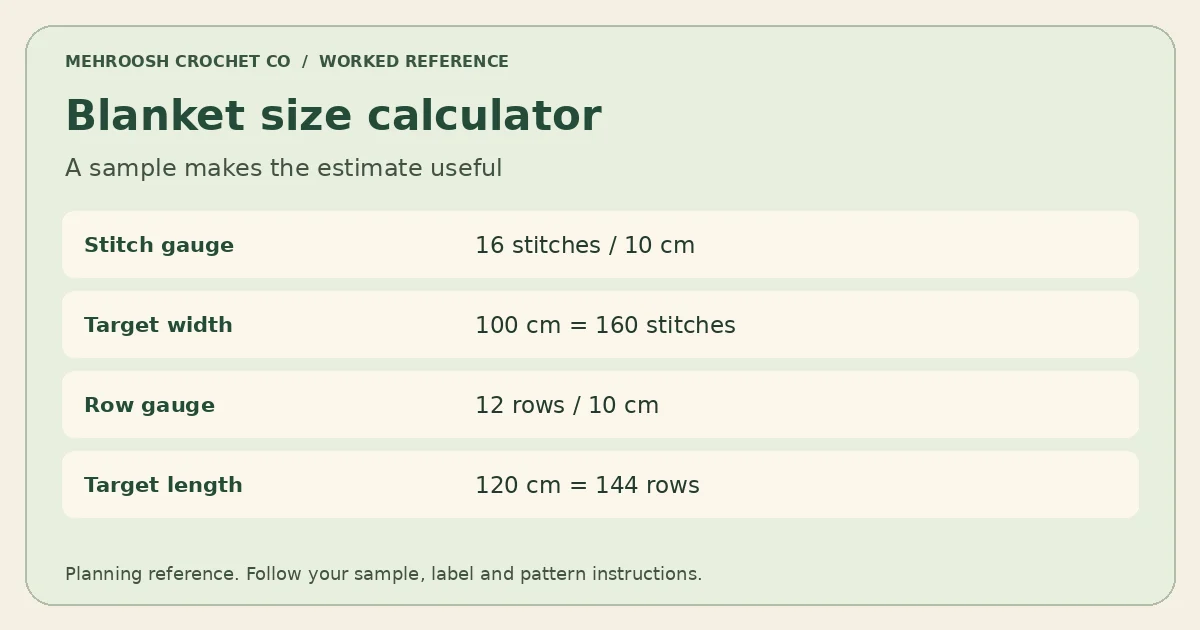
Suppose your sample has 16 stitches across 10 cm and 12 rows over 10 cm. For a main panel 100 cm wide and 120 cm long, the width calculation is 16 ÷ 10 × 100 = 160 working stitches. The length calculation is 12 ÷ 10 × 120 = 144 rows. These are planning figures at that sample gauge, rather than a guarantee of the finished measurements.
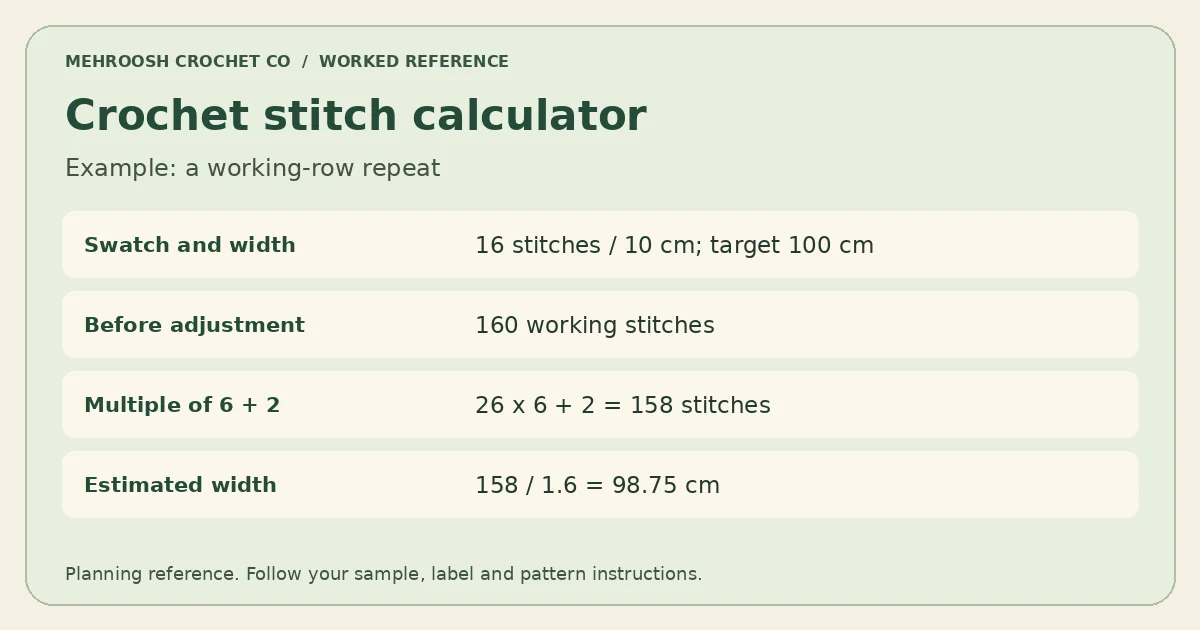
If the working row needs a multiple of six plus two extras, the closest permitted count becomes 158 stitches. At the same gauge that estimates 98.75 cm. Rounding up instead gives 164 stitches, estimating 102.5 cm. The row count is rounded separately; a stitch multiple does not also impose a row repeat.
Measure gauge before choosing a blanket size
Use the yarn, hook and stitch pattern planned for the blanket. Make the sample large enough to measure away from curling edges, then follow the pattern’s washing or blocking directions. Count complete stitches consistently. Our crochet stitch-counting guide explains how to locate stitch tops and avoid counting the live hook loop.
The Craft Yarn Council’s hook and gauge guidance also recommends comparing a swatch with the pattern gauge. A hook label alone cannot predict your finished fabric. If your sample changes after washing, use the finished sample measurements in the blanket size calculator.
Check these details before starting
A stitch count describes the fabric across a working row. It is not automatically the number of foundation chains. Skipped chains, turning chains and edge stitches depend on the instructions. Read the designer’s convention before making the chain; the pattern-reading guide can help with repeats and abbreviations.
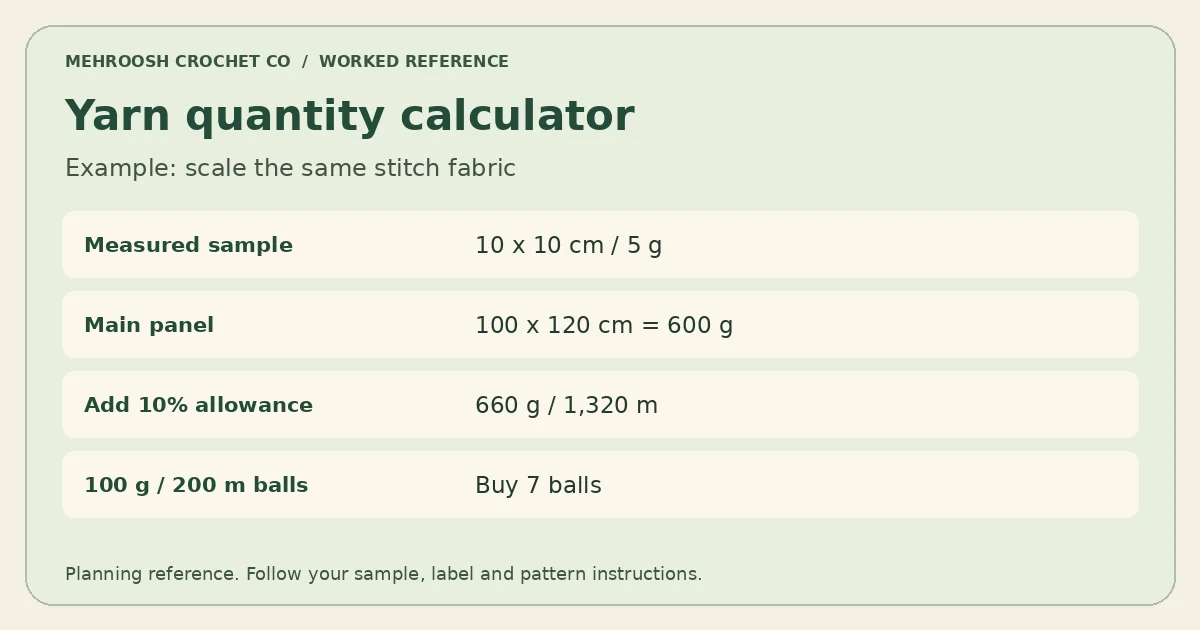
After a few rows, lay the panel flat and measure again. If it is too wide or narrow, check the stitch count, tension and gauge before continuing. For yarn planning, take the chosen dimensions to the Yarn Quantity Calculator and allow separately for a border, fringe or seams.
Blanket size calculator questions
Can I calculate a granny-square blanket?
This tool assumes a rectangle worked in straight rows. A blanket assembled from motifs needs the blocked motif size, joining method and arrangement. Do not treat a row count as the number of squares.
What if the pattern repeats every four rows?
The tool rounds individual rows. Adjust the result to a complete row repeat yourself, then multiply the revised row count by the height per row to check the new length.
Does this include the edging?
No separate edging is calculated. Plan the main panel and border together, and check both against your intended finished size before buying yarn.
Explore the other free crochet tools or find a project among our free crochet patterns.
Blanket size calculator: compare the whole project plan
The most useful result is one you can explain in your project notes. Write down the intended finished dimensions, the main-panel dimensions, your measured gauge and the repeat rule. These four details help you interpret the blanket size calculator and distinguish a rounding choice from a change in the actual fabric. Keep them with the pattern so that a later measurement has a clear reference.
Before using the blanket size calculator, decide which direction the rows will run. A striped blanket worked across its narrow side uses that side as the working-row width. If the design runs lengthways, the long side becomes the width entered for stitches. The other dimension is then built by adding rows. The tool cannot infer the construction direction from the finished rectangle.
Blanket size calculator example 1: a separate border
Suppose you want a finished blanket 100 cm wide and 120 cm long, with a border planned to measure 5 cm on every side. Subtract the border twice from each finished dimension. The main panel is therefore 90 cm wide and 110 cm long: 100 − 10 = 90 and 120 − 10 = 110. Enter the panel measurements rather than the finished measurements.
At a sample gauge of 16 stitches and 12 rows per 10 cm, the unrestricted panel estimate is 144 stitches and 132 rows. A 5 cm border on both sides would bring the planned dimensions back to 100 by 120 cm. The border itself still needs appropriate instructions and yarn. Its actual depth depends on its stitches, number of rounds and finishing, so measure the border rather than assuming every round is the same height.
Use the blanket size calculator again if a different border changes the available panel area. For example, choosing a narrower border gives the main fabric more space. Recheck the complete dimensions after changing the plan; do not add a new border allowance to a panel that already included the old one.
Blanket size calculator example 2: complete row repeats
A texture may need a six-row sequence even though the width calculation permits any stitch count. Suppose the gauge is 12 rows per 10 cm and the desired panel length is 103 cm. The unrounded estimate is 123.6 rows. A complete six-row sequence could finish at 120 or 126 rows if there are no separate setup or finishing rows.
At that gauge, 120 rows estimate 100 cm and 126 rows estimate 105 cm. Compare those alternatives with the space available and the designer’s ending instructions. If there are two setup rows, count them separately: the permitted totals would be two plus a whole number of six-row repeats. Stitch multiples and row repeats are independent decisions.
The blanket size calculator reports its row estimate without interpreting a pattern’s sequence. Record your revised row total beside the original result. This makes it easier to understand why your final plan differs from the nearest whole-row estimate and prevents an extra repeat from being added accidentally.
Blanket size calculator example 3: measurements in inches
Suppose your measured sample contains 14 stitches across 4 inches and 10 rows over 4 inches. For a panel 36 inches wide and 48 inches long, the unrestricted figures are 14 ÷ 4 × 36 = 126 stitches and 10 ÷ 4 × 48 = 120 rows. Both swatch distances and both target dimensions describe the same measurement system.
Do not enter the number 10 for the swatch width simply because another example used 10 cm. Your own sample was measured over 4 inches. The blanket size calculator needs the distance that belongs to the stitch count you actually entered. Label any numbers copied into a notebook so that a unit is not lost between measuring and calculating.
Blanket size calculator example 4: a changing width
Imagine the planned 160-stitch panel was expected to measure 100 cm, but the flat fabric measures 106 cm after several rows. First recount the stitches and check whether the measurement includes a border or stretched edges. Then compare the new fabric with the sample, including hook, yarn, stitch texture and finishing state.
If the count is correct, the observed fabric averages about 15.09 stitches per 10 cm: 160 ÷ 106 × 10. That differs from the original 16-stitch sample. It does not prove the tool calculated incorrectly; it shows that the current fabric and original sample have different measured gauge. Decide whether the present width is acceptable before continuing.
You can enter a representative new measurement in the blanket size calculator to compare alternatives. However, recalculating does not change rows already made. Avoid switching the stitch count partway through a straight blanket unless the design specifically calls for shaping. Reworking the beginning, accepting the revised size or choosing a different plan are separate construction decisions.
A short record to keep beside the blanket size calculator
Save the yarn name, hook diameter, stitch pattern, measured sample size and date of measurement. Add the chosen working stitches, total rows, row-repeat adjustment and intended border. While working, record a few actual width and length checks. These observations are more useful for a future matching panel than an unexplained final number.
Keep yarn purchasing separate from stitch planning. More stitches can change the required quantity, but this tool does not weigh fabric or price balls. Once you have settled dimensions and repeats with the blanket size calculator, use your sample with the yarn-planning tools linked above. Revisit the estimate if you change the stitch pattern, edging or finished measurements.
Continue your blanket plan
 Check the working stitch multiple
 Track completed rows
 Estimate the yarn requirement