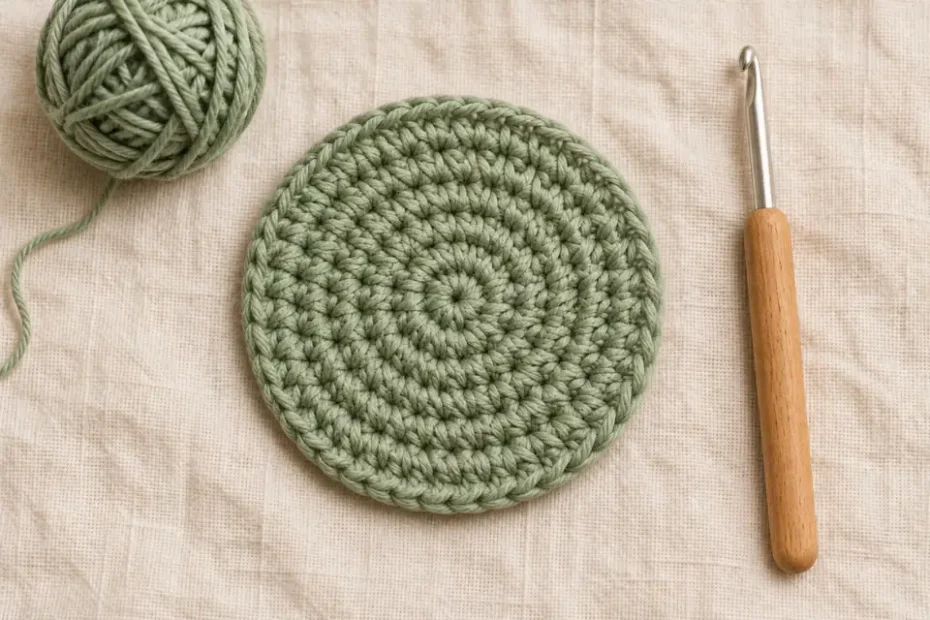
Learn how to crochet a flat circle with single crochet stitches and one stitch marker. You’ll start with six single crochets in a magic ring and finish Round 6 with 36 single crochets around the edge. Along the way, you’ll learn where to put each increase and how to spot the mistakes that make the fabric cup or ruffle.
On this page
Table of Contents
Supplies and stitch terms
Use smooth, light-coloured yarn, a hook within the range on your yarn label, a locking stitch marker, scissors and a yarn needle. The instructions use US crochet terms. If the stitch is new to you, practise with our single crochet lesson first.
sc means single crochet. inc means work two single crochets into one stitch from the previous round. An increase uses one old stitch and adds one stitch to the round total. st and sts mean stitch and stitches. To make a single crochet into an existing stitch, insert the hook under both top loops, yarn over and pull up a loop, then yarn over and pull through both loops on the hook.
How to crochet a flat circle in six rounds
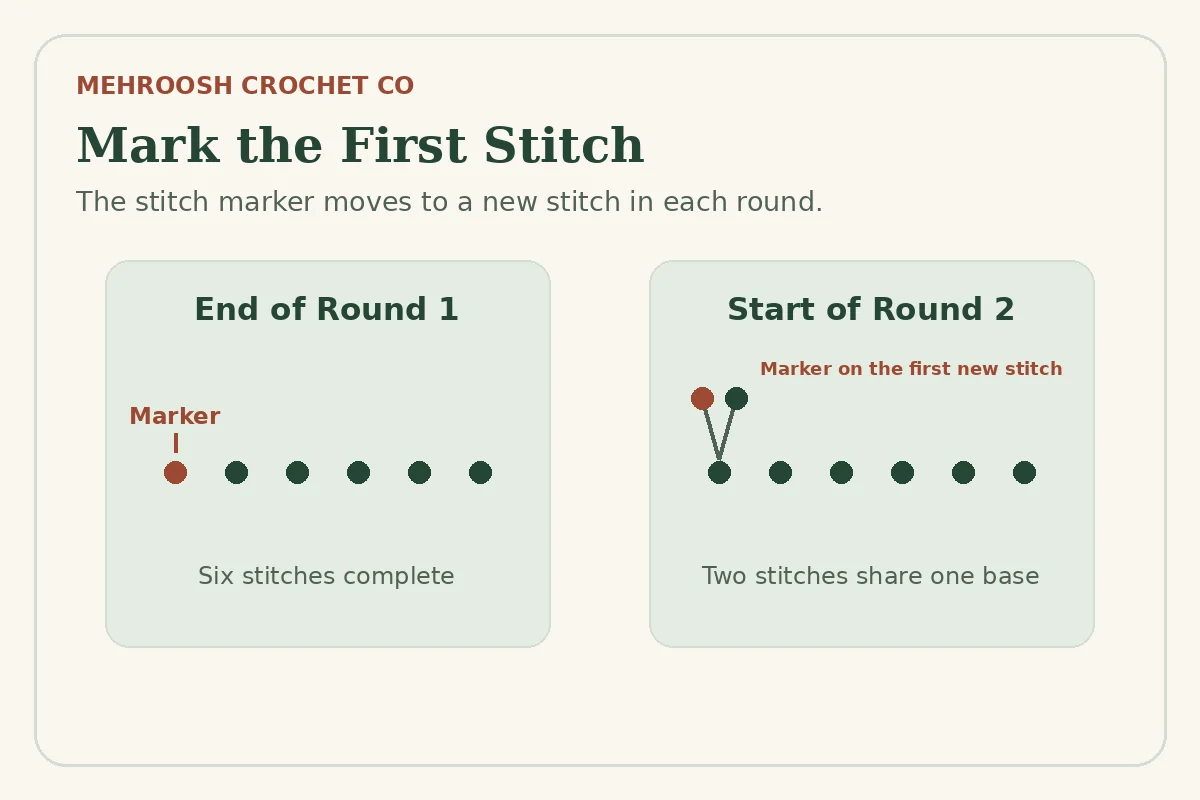
Work this flat circle in a continuous spiral. Keep the same side of the work facing you. Between rounds, go straight to the next stitch with no join or turning chain. Mark the first completed single crochet of each round. Finish the round when the marked stitch is the next stitch to work into. Pause and count the stitches you just made, including the marked one. Then remove the marker, work the first stitch of the next round into that spot and mark the new stitch. If that spot calls for an increase, mark the first of the two single crochets and work the second into the same base stitch.
Round 1. Make a magic ring and chain one to secure the loop. Work six single crochets into the ring, marking the first one. Pull the tail to close the centre. The setup chain stays outside the stitch count. Prefer a chain start? Chain two and work all six single crochets into the second chain from the hook. Count six single crochets with either start and leave the foundation chains out of the total.
| Round | What to crochet | Count at end |
|---|---|---|
| 1 | Work 6 sc into the centre. | 6 |
| 2 | Inc in every stitch. Work 2 sc into each of the 6 stitches. | 12 |
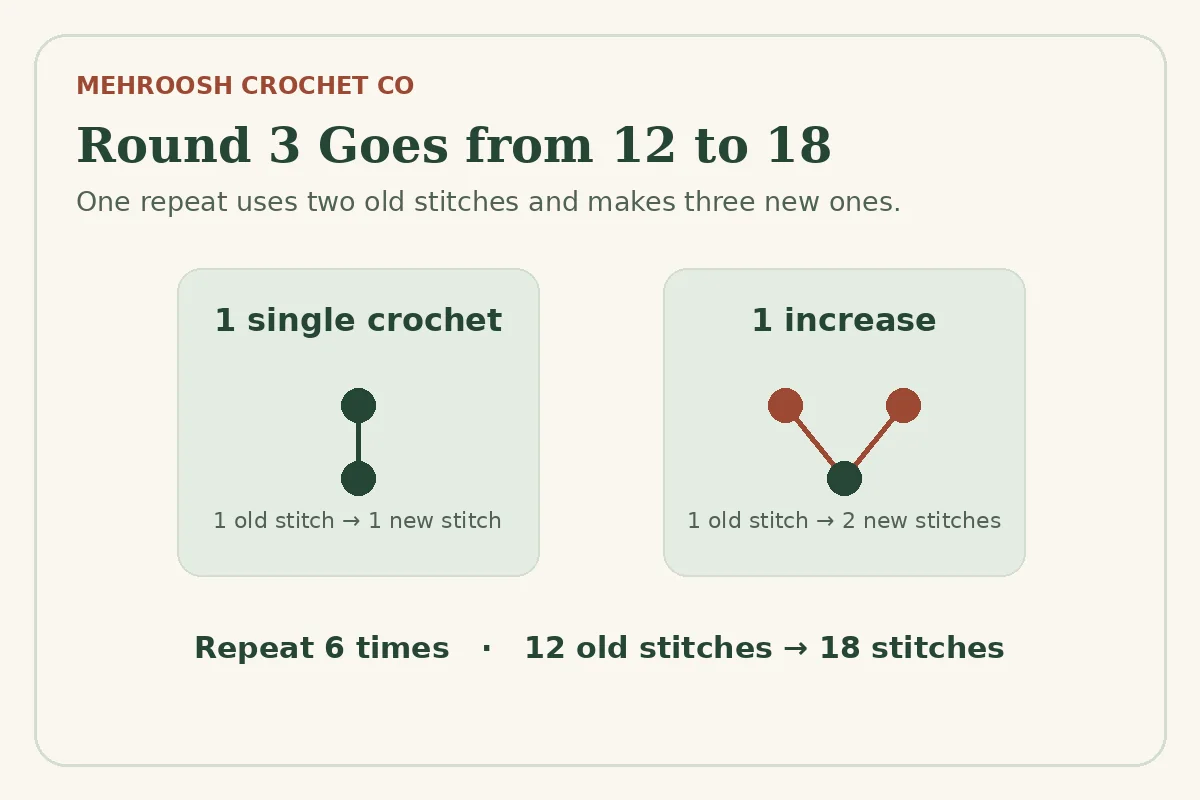
| 3 | [Sc in the next stitch, inc in the next stitch] 6 times. | 18 |
| 4 | [Sc in each of the next 2 stitches, inc in the next stitch] 6 times. | 24 |
| 5 | [Sc in each of the next 3 stitches, inc in the next stitch] 6 times. | 30 |
| 6 | [Sc in each of the next 4 stitches, inc in the next stitch] 6 times. | 36 |
Count the stitches you made. Each bracketed repeat contains one increase. Work the full repeat exactly six times. For example, in Round 3 you use two stitches from Round 2 to make three new stitches per repeat. Six repeats use all 12 stitches and make 18. From Round 2 onward, the six increases add six stitches to the previous round’s total. Count one stitch per completed top V, including both Vs made by an increase. The live loop on the hook stays outside the count.
If your flat circle is the size you want after six rounds, fasten off and weave in both tails. A flat circle worked in a continuous spiral leaves a small step at the edge. For a gentler step, work a loose slip stitch into the first stitch of the final round before fastening off. Make this optional slip stitch only after counting all 36 single crochets. It is a finishing stitch and adds nothing to the round total.
How to find a missing or extra stitch
Use the marker to check both ends of the round. In Round 2, the marked stitch from Round 1 takes the first two single crochets. Insert the hook under the same two top loops for both. When you reach the final stitch from Round 1, it also takes two single crochets. You should now have used six bases. Pause before working into the new marked stitch, which belongs to Round 2. This check is helpful when the last Round 1 stitch sits close to the tightened ring.
Find a missing increase. Say you finish Round 3 with 17 single crochets. First, check whether you accidentally skipped a base stitch. If you used all 12 bases, look for the place where two successive bases each received just one stitch inside the same repeat. Each complete repeat should have one base with one stitch and one base with two. Clip a spare marker at the suspect spot, undo to it and rework from there. Marking the spot helps if you need to set the work down.
Locate an extra stitch. If Round 4 has 25 single crochets, check whether you crocheted into the marked stitch after the sixth repeat. That extra single crochet belongs to the next round. Undo it, then count again. If you stopped at the marker and still count 25, look for a base that received an unintended second stitch, or an increase base with three stitches. Follow the two top loops back to their base to see which stitches share it.
Check the spacing as well as the total. A count of 24 can hide a misplaced increase. In the standard Round 4 sequence, after every increase you should have two bases that take one single crochet each before the next increase. The same spacing wraps around the stitch marker when you look at the completed round. If two increases sit next to each other, find the missing increase farther along before undoing anything. This helps you fix the local bump while keeping the round’s total at 24.
Undo a stitch without losing your place. Pull the hook out of the live loop and gently tug the working yarn until the extra stitch comes out. Return the hook to the live loop and draw it back to the width of the hook shaft. Check that the first-stitch marker still marks the current round. If you undo past it, find the first newly worked stitch again before counting. To check your place, compare the last completed repeat with the table and continue from the next unused stitch.
Match two circles for a project. For a pair of flat circle coasters, use the same yarn, hook and number of rounds for both. Measure across the widest part without stretching the fabric. The same stitch count can give a different diameter when your tension changes. If the circles need to match, compare them after the same round and use the same finish on both edges. For a larger flat circle, check the diameter again after every completed round.
Flat circle fixes for cupping, ruffles and six-sided edges
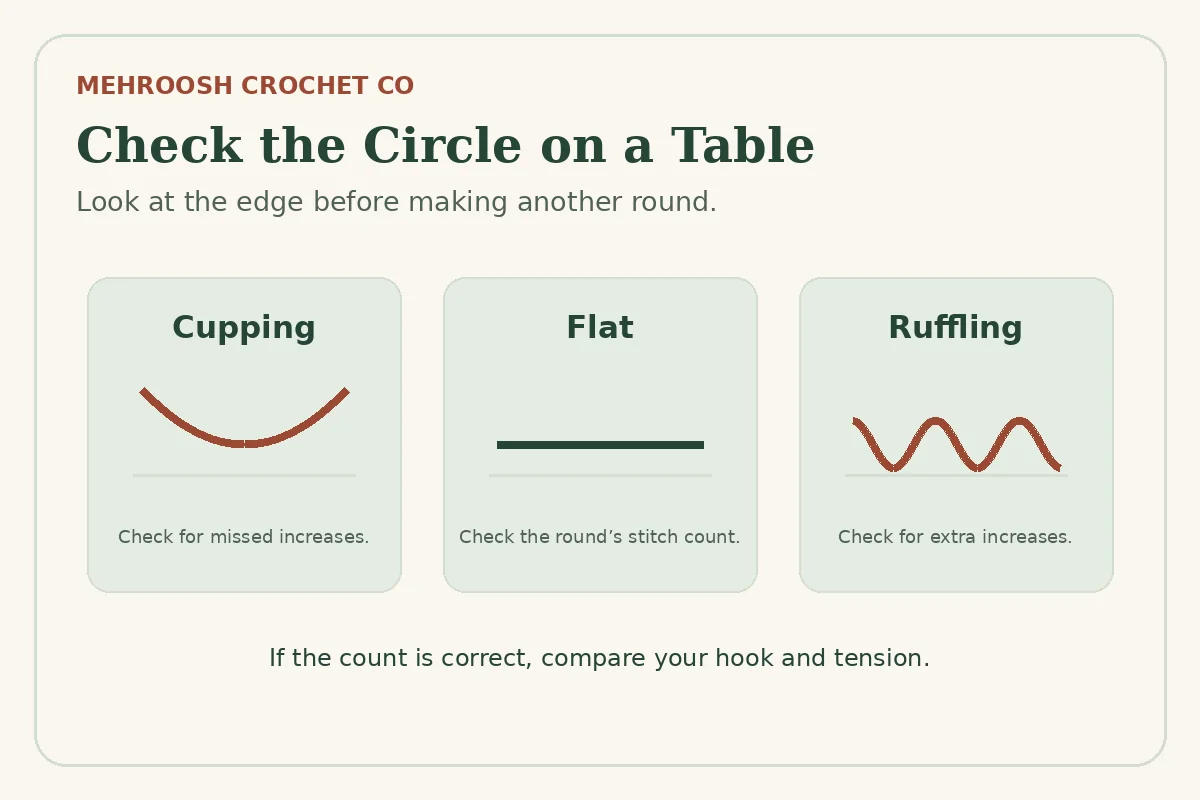
The circle cups like a bowl. Lay your flat circle on a table without stretching it. Count the most recent round and make sure you used every stitch from the previous round. If you missed an increase, undo back to the mistake and add it. If the count is correct and your flat circle keeps cupping, make a small second sample with a slightly larger hook or more relaxed tension. If the same yarn and tension still cup, the circle may need more evenly spaced increases.
Your flat circle has a ruffled edge. Check for an extra increase or a stitch worked twice by mistake. Compare your count with the table as soon as you notice waves. If the count matches and the edge still ruffles, compare a sample made with a slightly smaller hook. Your yarn and stitch shape may need fewer evenly spaced increases.
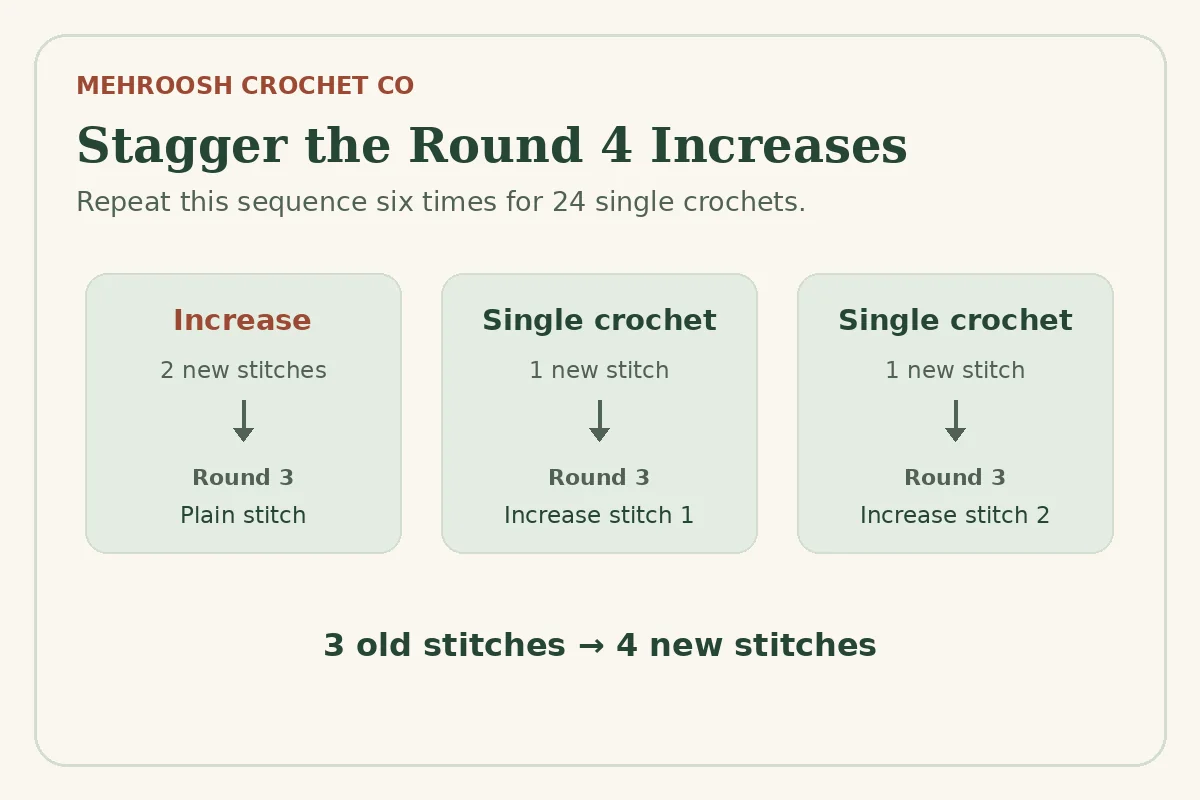
Your flat circle has six corners. Increases can form six visible corners when they line up from one round to the next. To stagger the increases after the Round 3 written above, work Round 4 as [inc in the next stitch, sc in each of the next 2 stitches] six times. This places each increase in the plain single crochet of a Round 3 repeat. Each repeat still uses 3 old stitches and makes 4 new stitches, so the total is 24. Continue with the Round 5 instructions in the table.
How to make a larger flat circle
Keep working in the spiral if you want a larger flat circle. In Round 7, work [sc in each of the next 5 stitches, inc in the next stitch] six times for 42 stitches. In Round 8, work [sc in each of the next 6 stitches, inc in the next stitch] six times for 48 stitches. Lay the work flat after each round to check how your yarn is behaving. Finish once the circle reaches the size you want.
For a flat circle with a clear end to each round, follow our Joined Rounds tutorial to practise the slip-stitch join. For another worked example, see Lion Brand’s joined-round circle guide. Use our guide to counting crochet stitches to find the top Vs, or keep track of completed rounds with the crochet row counter.
Flat circle FAQs
Can I crochet a flat circle without a magic ring?
Yes. Chain two, then work all six single crochets into the second chain from the hook. Mark the first single crochet and continue in a spiral. The centre may be a little more visible than with an adjustable ring.
Do I join each round with a slip stitch?
Keep working in a continuous spiral for this pattern. At the marker, begin the next round in the marked stitch. The optional slip stitch at the very end smooths the edge and stays outside the single crochet count.
How big will my flat circle be after six rounds?
Round 6 ends with 36 single crochets. The diameter depends on your yarn, hook and tension. Lay the swatch flat and measure straight across its centre without stretching it. For a larger piece, use the optional rounds and measure again.
Can I use half double crochet or double crochet instead?
Use the round counts in this tutorial for US single crochet. Taller stitches take the edge farther out in each round, so a flat circle in half double crochet or double crochet needs a different increase pattern.
Can I block a circle that cups or ruffles?
Gentle blocking can smooth small tension differences. If the edge still bowls up or waves when the piece is resting flat, check the stitch count and spacing first. Correct missed or extra increases before blocking.